Category: Learning & Resources

Educational resources, documentaries and introductory explainers

  • Cloudspotting on Mars Project

    Cloudspotting on Mars Project

    by Zooniverse

    October 30, 2024

    Get ready to explore the skies of Mars: we’re thrilled to launch Cloudspotting on Mars: Shapes!

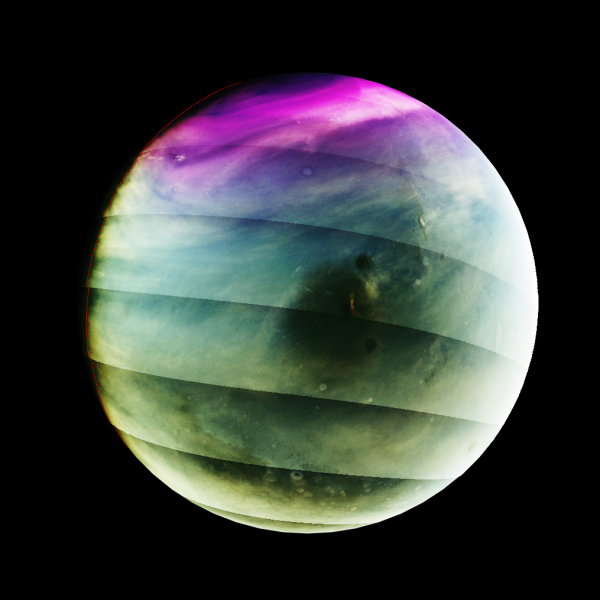
    In this fun new project, you’ll help us identify and map different types of Martian clouds using data from NASA’s MAVEN mission. Dive into the Red Planet’s atmosphere, spot icy clouds, and help scientists unlock the mysteries of Martian weather patterns!

    The MAVEN spacecraft has been snapping stunning images for years, and we need your help to sort through them. Your discoveries will be part of a cool cloud library that will help scientists better understand Mars’ ever-changing atmosphere.

    Join the adventure and start cloudspotting today—visit: https://www.zooniverse.org/projects/matteocrismani/cloudspotting-on-mars-shapes

    Has this new NASA citizen science project sparked your interest? Consider subscribing to our NASA-Zooniverse email list to receive updates and news regarding broader NASA citizen science projects and efforts.

    If interested, please follow these instructions to sign up:

    1. Log in to your Zooniverse account.

    2. Visit https://www.zooniverse.org/settings/email

    3. Click the checkbox under “Zooniverse partner email preferences” to sign up for periodic email updates from NASA.

  • What Are Black Holes?

    What Are Black Holes?

    by Francis Reddy, NASA

    September 08, 2020

    A black hole is an astronomical object with a gravitational pull so strong that nothing, not even light, can escape it. A black hole’s “surface,” called its event horizon, defines the boundary where the velocity needed to escape exceeds the speed of light, which is the speed limit of the cosmos. Matter and radiation fall in, but they can’t get out.

    Two main classes of black holes have been extensively observed. Stellar-mass black holes with three to dozens of times the Sun’s mass are spread throughout our Milky Way galaxy, while supermassive monsters weighing 100,000 to billions of solar masses are found in the centres of most big galaxies, ours included.

    Astronomers had long suspected an in-between class called intermediate-mass black holes, weighing 100 to more than 10,000 solar masses. While a handful of candidates have been identified with indirect evidence, the most convincing example to date came on May 21, 2019, when the National Science Foundation’s Laser Interferometer Gravitational-wave Observatory (LIGO), located in Livingston, Louisiana, and Hanford, Washington, detected gravitational waves from a merger of two stellar-mass black holes. This event, dubbed GW190521, resulted in a black hole weighing 142 Suns.

    A stellar-mass black hole forms when a star with more than 20 solar masses exhausts the nuclear fuel in its core and collapses under its own weight. The collapse triggers a supernova explosion that blows off the star’s outer layers. But if the crushed core contains more than about three times the Sun’s mass, no known force can stop its collapse to a black hole. The origin of supermassive black holes is poorly understood, but we know they exist from the very earliest days of a galaxy’s lifetime.

    Once born, black holes can grow by accreting matter that falls into them, including gas stripped from neighbouring stars and even other black holes.

    In 2019, astronomers using the Event Horizon Telescope (EHT) — an international collaboration that networked eight ground-based radio telescopes into a single Earth-size dish — captured an image of a black hole for the first time. It appears as a dark circle silhouetted by an orbiting disk of hot, glowing matter. The supermassive black hole is located at the heart of a galaxy called M87, located about 55 million light-years away, and weighs more than 6 billion solar masses. Its event horizon extends so far it could encompass much of our solar system out to well beyond the planets.

    Another important discovery related to black holes came in 2015 when scientists first detected gravitational waves, ripples in the fabric of space-time predicted a century earlier by Albert Einstein’s general theory of relativity. LIGO detected the waves from an event called GW150914, where two orbiting black holes spiraled into each other and merged 1.3 billion years ago. Since then, LIGO and other facilities have observed numerous black hole mergers via the gravitational waves they produce. 


    These are exciting new methods, but astronomers have been studying black holes through the various forms of light they emit for decades. Although light can’t escape a black hole’s event horizon, the enormous tidal forces in its vicinity cause nearby matter to heat up to millions of degrees and emit radio waves and X-rays. Some of the material orbiting even closer to the event horizon may be hurled out, forming jets of particles moving near the speed of light that emit radio, X-rays and gamma rays. Jets from supermassive black holes can extend hundreds of thousands of light-years into space.

    NASA’s Hubble, Chandra, Swift, NuSTAR, and NICER space telescopes, as well as other missions, continue to take the measure of black holes and their environments so we can learn more about these enigmatic objects and their role in the evolution of galaxies and the universe at large.

    Image:

    The first picture of a black hole was made using observations of the center of galaxy M87 taken by the Event Horizon Telescope. The image shows a bright ring formed as light bends in the intense gravity around a black hole 6.5 billion times the Sun’s mass.

    Credit: Event Horizon Telescope Collaboration

    Image:

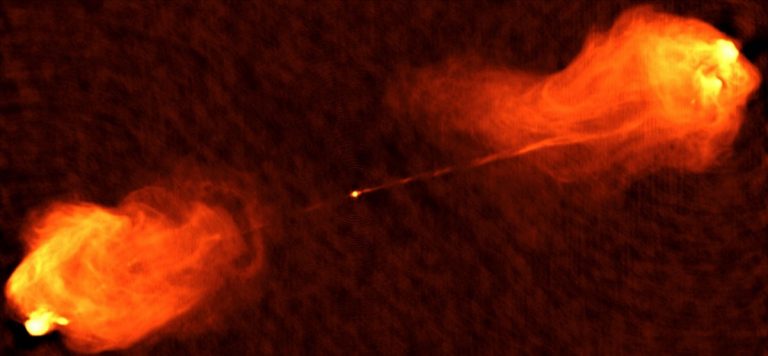
    Radio data from the National Science Foundation’s Very Large Array facility was used to construct this image of Cygnus A, the brightest radio source in the sky located outside our galaxy. Long, thin particle jets produced by a supermassive black hole in the galaxy’s center link to vast lobes where speeding electrons trapped by magnetic fields emit radio waves. From tip to tip, the structure spans half a million light-years.

    Credit: NRAO/AUI

  • What is a ‘Rogue Star’?

    What is a ‘Rogue Star’?

    A rogue star, also known as an intergalactic or orphan star, is a star that drifts through space without being gravitationally bound to a galaxy or star cluster. Unlike most stars, which exist within the structured environment of galaxies (like our Sun in the Milky Way), rogue stars are solitary travelers in the vast emptiness of space, moving independently without a nearby galaxy to call home.

    Rogue stars can originate from several potential processes:

    1. Galactic Interactions: In galaxy collisions or interactions, intense gravitational forces can pull stars out of galaxies and propel them into intergalactic space.

    2. Stripping: During interactions with massive galactic clusters, gravitational forces (known as tidal forces) can strip stars from galaxies, leaving them to wander alone.

    3. Early Universe Phenomena: Some rogue stars may have formed independently in the early universe, perhaps in small, loosely bound galaxies that later disintegrated or “bled” stars into space due to weaker gravitational pulls.

    Rogue stars are intriguing to scientists because they offer a unique perspective on the history and structure of the universe, as well as a potential way to understand dark matter.

    Here is a list of notable rogue stars and their past or future encounters with our solar system:

    1. Gliese 710 (Constellation Serpens)

    • Type: Rogue star, not a hypervelocity star.

    • Speed: About 51,499 km/h.

    • Visibility: Magnitude 9.66 (requires a telescope to observe).

    • Approach Timeline: In approximately 1.29 million years, it will come within 4,303 AU of the Sun, closer than Pluto.

    • Outcome: Will not collide with our solar system but will become the closest star to the Sun, surpassing Proxima Centauri’s current distance of 4 light-years (268,142 AU).

    2. V2689 Orionis (Gliese 208)

    • Past Encounter: Passed Earth at a distance of 5 light-years around 50,000 years ago, farther out than Proxima Centauri.

    • Current Status: This close encounter is over, and the star continues to travel away from us.

    3. Scholz’s Star (Constellation Monoceros)

    • Past Encounter: Estimated to have crossed through the Oort Cloud approximately 70,000 years ago.

    • Effect on Solar System: No significant impact on Earth, but it may have nudged objects in the Oort Cloud.

    4. HIP 85605

    • Current Trajectory: Moving toward our solar system, expected to pass through the Oort Cloud.

    • Approach Timeline: Estimated to arrive within 240,000 to 470,000 years.

    • Potential Impact: May disturb the Oort Cloud, possibly redirecting comets toward the Sun. There will be time to address any threats posed by comet collisions.

    5. Gamma Microscopii

    • Past Close Encounter: Passed within 0.35 to 1.34 parsecs (1.1 to 4.3 light-years) of the Sun approximately 3.9 million years ago.

    • Type: A large G-type giant star (G6 or G8III) with about 2.5 times the mass of the Sun.

    • Impact on Solar System: Likely influenced the Oort Cloud, potentially sending comets toward Earth. Some impact craters on Earth may be linked to this encounter.

    These stars demonstrate how close stellar encounters can potentially influence the solar system, particularly by disturbing the Oort Cloud and potentially sending comets inward. The timeframes for such encounters are vast, giving Earth plenty of time to prepare for any indirect effects.

    Image:

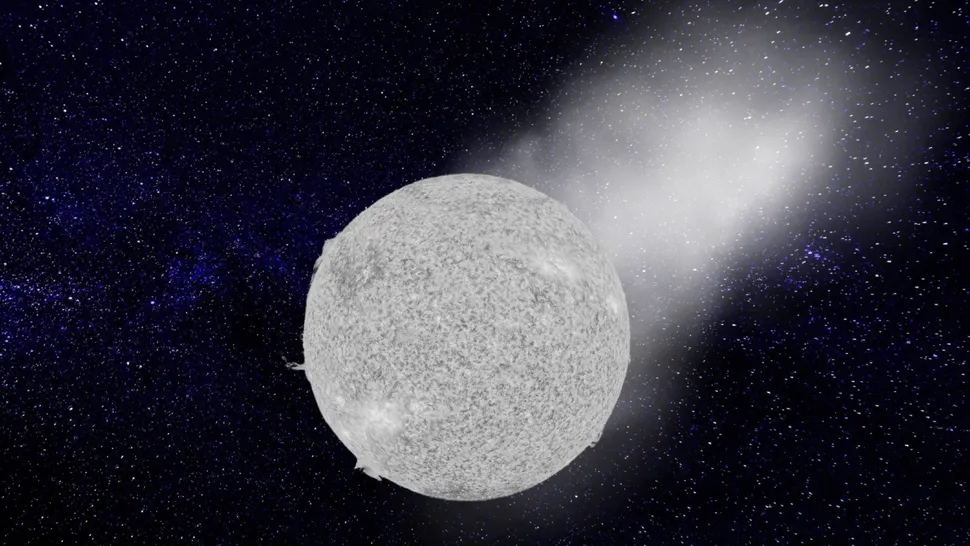
    Illustration of a ‘runaway’ white dwarf. Credit Robert Lea

  • Why build bigger and bigger telescopes, such as European Southern Observatory’s Extremely Large Telescope (ELT

    Why build bigger and bigger telescopes, such as European Southern Observatory’s Extremely Large Telescope (ELT

    by Kate Green

    October 19, 2024

    The drive to build bigger and bigger telescopes, like the ESO’s Extremely Large Telescope (ELT), stems from the desire to push the boundaries of our understanding of the universe. Larger telescopes have greater light-gathering power and higher resolution, enabling astronomers to see fainter and more distant objects in unprecedented detail.

    Here’s why bigger telescopes are essential, and how they benefit not only science but also society as a whole:

    Why Aim for Bigger Telescopes?

    1. Better Light-Gathering Power:

      • The size of a telescope’s primary mirror determines how much light it can collect. Larger telescopes, like the ELT with its 39-meter mirror, can capture light from extremely distant and faint objects that smaller telescopes cannot detect. This allows us to look further back in time, revealing the early stages of the universe, star formation, and galaxy evolution.

    2. Higher Resolution:

      • Bigger telescopes also provide higher angular resolution, which means they can discern finer details. The ELT’s adaptive optics system will correct for atmospheric distortion, enabling it to deliver images that are much sharper than those of smaller telescopes or even those taken by space-based telescopes. This clarity is vital for studying the surfaces of distant exoplanets or resolving the structure of far-off galaxies.

    3. Addressing Fundamental Questions:

      • Larger telescopes like the ELT are essential for tackling some of the most pressing questions in astronomy, such as:

        • What are the conditions for life beyond Earth?

        • How did galaxies and black holes form in the early universe?

        • What is the nature of dark matter and dark energy?

    How Does This Effort Pay Back Society?

    While the primary goal of building large telescopes is to advance our understanding of the cosmos, the societal impact of such projects goes far beyond astronomy.

    Here are some key ways this investment benefits society as a whole:

    1. Technological Innovation:

      • The engineering challenges involved in constructing and operating massive telescopes like the ELT drive the development of cutting-edge technologies. These innovations often find applications in other fields. For example:

        • Adaptive optics technology, developed for telescopes, is now used in medical imaging, such as ophthalmology, to improve the quality of retinal scans.

        • Precision engineering techniques, developed to build the telescope’s components, benefit industries such as manufacturing and aerospace.

    2. Inspiring Education and STEM Careers:

      • Large-scale scientific projects like the ELT inspire future generations of scientists, engineers, and innovators. These projects are often used as tools to promote STEM education (Science, Technology, Engineering, Mathematics), encouraging students to pursue careers in these fields. This helps develop a highly skilled workforce that drives technological advancement and economic growth.

    3. Global Collaboration and Diplomacy:

      • Telescopes like the ELT are often international projects, bringing together expertise and funding from countries around the world. This promotes global collaboration in science and fosters peaceful cooperation between nations.

    4. Economic Development in Host Regions:

      • The construction and operation of large observatories contribute to local and regional economic development. In the case of the ELT, Chile’s Atacama Desert has become a hub for astronomical research, attracting scientists, engineers, and tourists. Local economies benefit from the creation of jobs, infrastructure development, and international investment.

    5. Spinoff Technologies:

      • Many technologies developed for astronomy later find widespread applications in everyday life. For example:

        • Data analysis algorithms developed for processing astronomical data are now used in finance, healthcare, and artificial intelligence.

        • Cryogenic technologies, which are used to cool sensitive astronomical instruments, have applications in fields like superconductors and quantum computing.

    6. Cultural and Philosophical Impact:

      • Astronomy has a profound impact on how humans see their place in the universe. Discovering exoplanets, studying black holes, or learning about the early universe encourages a sense of wonder and curiosity. These discoveries also fuel philosophical discussions about life, the cosmos, and humanity’s future, enriching culture and society.

    Conclusion:

    The drive to build larger telescopes, like the ELT, is not only about making groundbreaking astronomical discoveries. It’s about pushing the limits of human knowledge, fostering innovation, and inspiring future generations. The benefits extend beyond the scientific community, impacting technology, education, global collaboration, and even the way we perceive our place in the universe. The investment in large-scale observatories ultimately pays back to society in numerous ways, both tangible and intangible.

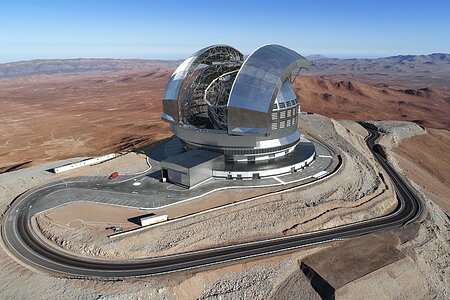
    Image: Artist’s impression of completed Extremely Large Telescope (ELT). Credit: European Southern Observatory (ESO)