Author: Kate Green

  • Horsehead Nebula (Euclid, Hubble, and Webb images)

    Horsehead Nebula (Euclid, Hubble, and Webb images)

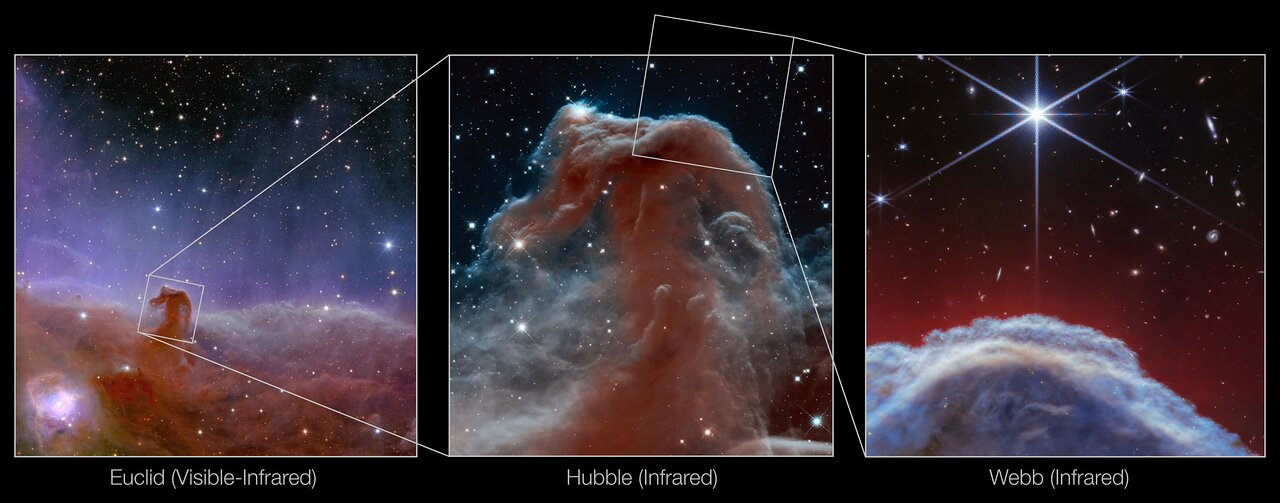
    This image showcases three views of one of the most distinctive objects in our skies, the Horsehead Nebula.

    This object resides in part of the sky in the constellation Orion (The Hunter), in the western side of the Orion B molecular cloud. Rising from turbulent waves of dust and gas is the Horsehead Nebula, otherwise known as Barnard 33, which resides roughly 1300 light-years away.

    The First Image (left):

    Released in November 2023, it features the Horsehead Nebula as seen by ESA’s Euclid telescope. Euclid captured this image of the Horsehead in about one hour, which showcases the mission’s ability to very quickly image an unprecedented area of the sky in high detail.

    The Second Image (middle):

    This image shows the NASA/ESA Hubble Space Telescope’s infrared view of the Horsehead Nebula, which was featured as the telescope’s 23rd anniversary image in 2013. This image captures plumes of gas in the infrared and reveals a beautiful, delicate structure that is normally obscured by dust.

    The Third Image (right): 

    The image features a new view of the Horsehead Nebula from the NASA/ESA/CSA James Webb Space Telescope’s NIRCam (Near-InfraRed Camera) instrument. It is the sharpest infrared image of the object to date, showing a part of the iconic nebula in a whole new light, and capturing its complexity with unprecedented spatial resolution.


    Image: A collage of three images of the Horsehead Nebula. In the left image labelled “Euclid (Visible-Infrared)”, the Nebula is seen amongst its surroundings. A small box around it connects to the second image labelled “Hubble (Infrared)”, where the Nebula is zoomed in on. A portion of the Nebula’s head has another box, which leads with a callout to the third image, labelled “Webb (Infrared)”, of that area.

  • Spot NASA’s Advanced Composite Solar Sail System (ACS3) which is now visible in the night sky.

    Spot NASA’s Advanced Composite Solar Sail System (ACS3) which is now visible in the night sky.

    By Brett Tingley

    September 06, 2024

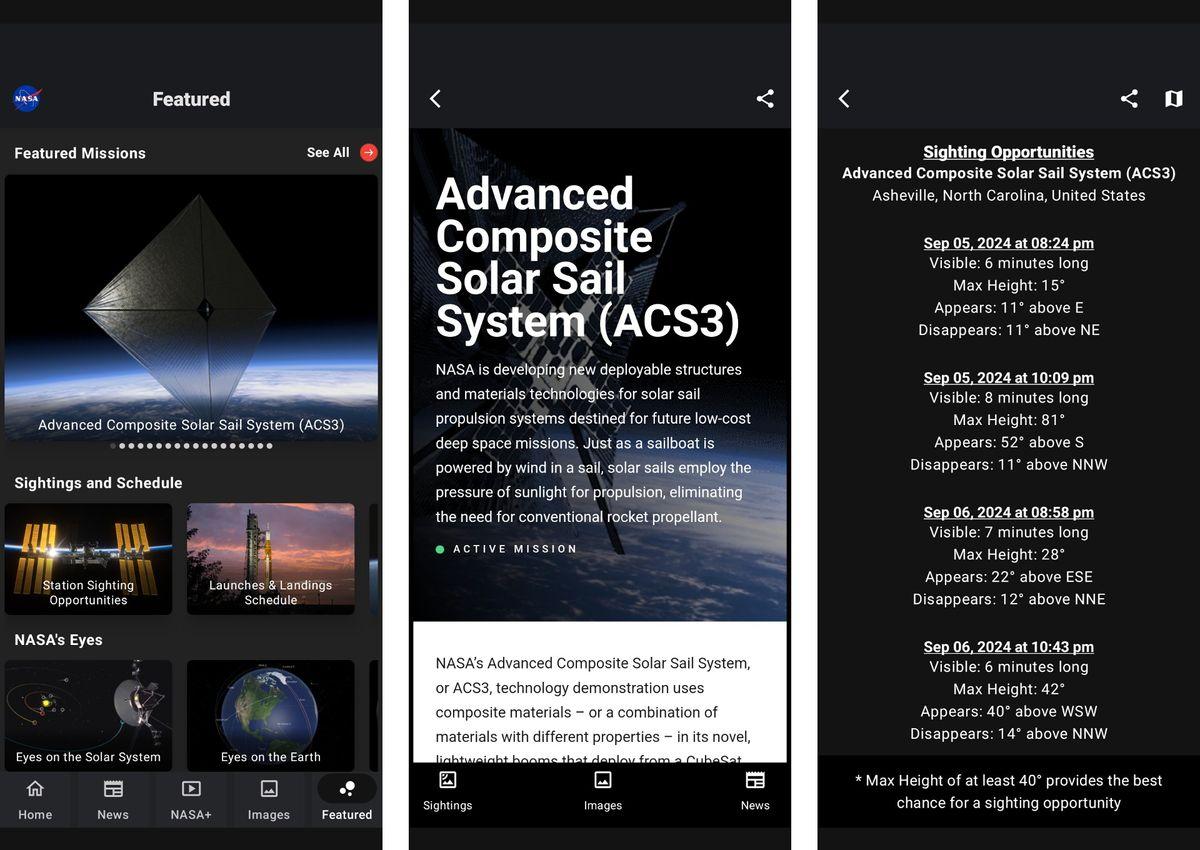
    NASA’s Advanced Composite Solar Sail System (ACS3) can be seen with the naked eye as it orbits Earth, and can be tracked with a helpful app.

    An experimental NASA solar sail can be seen in the night sky as it orbits the Earth.

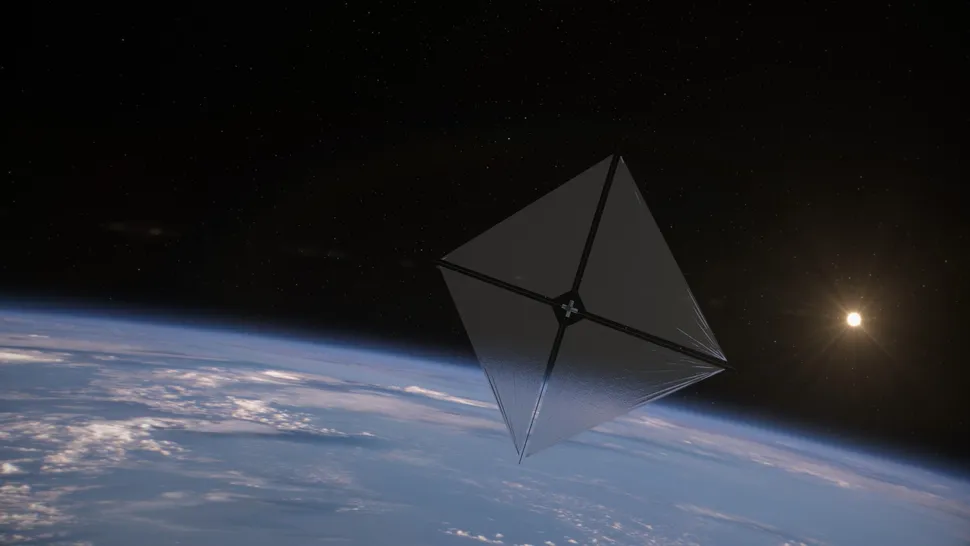
    NASA’s Advanced Composite Solar Sail System (ACS3) launched in April 2024 atop a Rocket Lab Electron rocket. The mission is designed to test solar sail technology to help NASA develop larger spacecraft in the future using this next-generation propulsion system. Solar sails work similarly to nautical sails, but instead of being pushed by wind, they are impacted by the pressure of sunlight as photons bounce off the reflective material they are made from.

    On August 29, the ACS3 spacecraft deployed its 80-square-metre solar sail while operating at an altitude about 1,000 kilometres above Earth, which is nearly twice as high as the International Space Station. As the ACS3 spacecraft orbits Earth, its large surface area means it reflects enough sunlight to be seen from the ground. Under some conditions, the solar sail demonstrator could even appear as bright as Sirius, the brightest star in the night sky. If you want to see it for yourself, you are in luck: NASA has an app that lets you track sighting opportunities from your location.


    To most easily see NASA’s ACS3 solar sail, you will want to download the official NASA app from the Google Play Store or Apple App Store.

    From there, navigate to the “Featured” tab at the bottom of the app. You should see a section for the Advanced Composite Solar Sail System (ACS3) under “Featured missions.”

    Once you tap on that mission, you will be able to then tap on “Sightings.” If you’ve allowed the app to access your location, the app will give you a list of times and dates for when you’ll be able to see NASA’s solar sail, including in what direction of the sky it will be visible, its celestial altitude and the duration of each sighting.

    Satellite tracker Kevin Fetter caught ACS3 on camera on September 05 as it passed near one of the brightest stars in the night sky. “It got bright for a short time as it was passing by the star. Briefly it was just as bright as Vega, the 5th brightest star in the night sky,” Fetter stated to Space.com.


    Some researchers believe solar sails could advance space travel in the future by allowing the development of spacecraft that are lightweight yet can still travel great distances without the need for carrying heavy fuels.

    Solar sails can theoretically also reach high speeds, as it is believed their unique method of propulsion can grant them infinite acceleration.

    Solar sails could lower the cost of deep space exploration while also enabling missions of long durations, since their fuel supplies never exhaust. If ACS3 can successfully manoeuvre in orbit and succeed in its mission, it could potentially help develop more advanced solar sail spacecraft.

    “The hope is that the new technologies verified on this spacecraft will inspire others to use them in ways we haven’t even considered,” said Alan Rhodes, the ACS3 mission’s lead systems engineer at NASA’s Ames Research Centre, in an agency statement.

    Scientists have already proposed using solar sails to send missions to Saturn’s moon Enceladus or Jupiter’s moon Europa, while the Breakthrough Starshot initiative has for years suggested that solar sails propelled by lasers could reach Alpha Centauri, the closest star system to our own, to search for life.

    Image #1: This artist’s concept shows the Advanced Composite Solar Sail System spacecraft sailing in space using the energy of the sun. (Image credit: NASA/Aero Animation/Ben Schweighart)


    Image #2: Screenshots of the NASA app and the features of its Advanced Composite Solar Sail System (ACS3) section. (Image credit: Future/Brett Tingley)

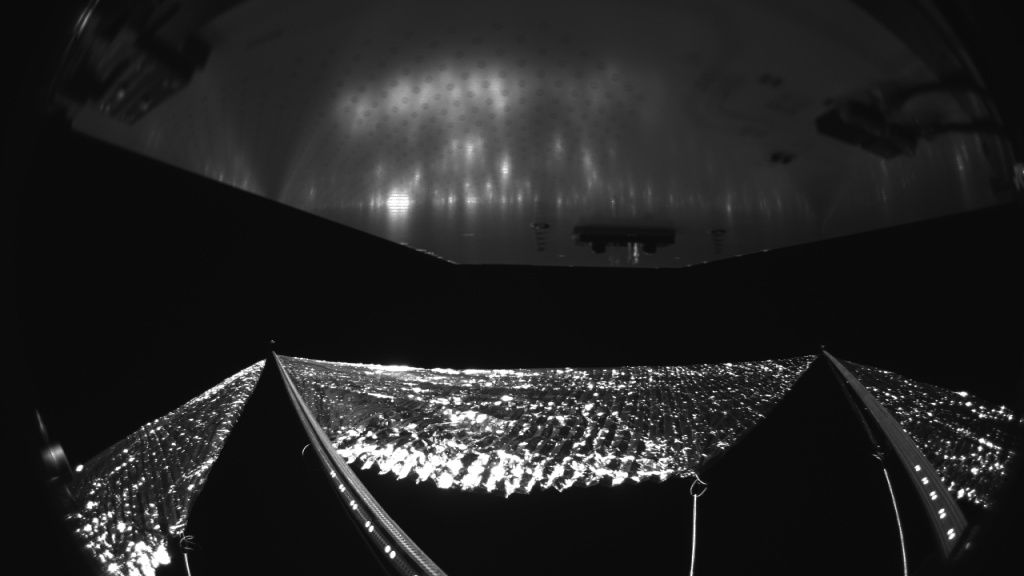
    Image #3: A photo taken from aboard NASA’s Advanced Composite Solar Sail System (ACS3) spacecraft. (Image credit: NASA)

  • Education Resources From Space Agencies

    Education Resources From Space Agencies

    Zooniverse – Citizen Scientist Projects

    • The Zooniverse enables everyone to take part in real cutting-edge research in many fields

    across the sciences, humanities, and more. The Zooniverse creates opportunities for you to unlock answers and contribute to real discoveries.

    European Space Agency (ESA) Teach with space – Secondary classroom resources

    • The secondary school level classroom resources are produced for the 14 – 18 years old age

    range (secondary, middle and upper school level) and they cover a wide range of curricular subjects such as: physics, chemistry, astronomy, mathematics, biology, etc. Each classroom resource is composed of a teacher guide and practical activities dedicated to the students.

    European Space Agency (ESA) Teach with space – Primary classroom resources

    • The primary school level classroom resources range from 6 to 12 years of age. They cover a

    wide range of curricular topics related to science, mathematics, technology, engineering and arts. Each classroom resource is composed of a teacher guide and student worksheets with practical activities.

    Code a Mars Helicopter Video Game:

    • Create a video game that lets players explore the Red Planet with a helicopter like the one

    going to Mars with NASA’s Perseverance rover! Use Scratch, a visual programming language and think like NASA space-mission planners to design your game!

    NASA: Pathways to Astronomy Education Resources

    • Welcome to Imagine the Universe! This site is intended for students aged 14 and up, and for anyone interested in learning about our universe.

    NASA’s Starchild: A Learning Centre for Young Astronomers

    • StarChild is a learning center for young astronomers ages 5-13 to learn about the solar system,the Milky Way galaxy, and the universe beyond.

  • Japan launches spy satellite on penultimate mission of H-2A rocket

    Japan launches spy satellite on penultimate mission of H-2A rocket

    by Mike Wall

    September 26, 2024

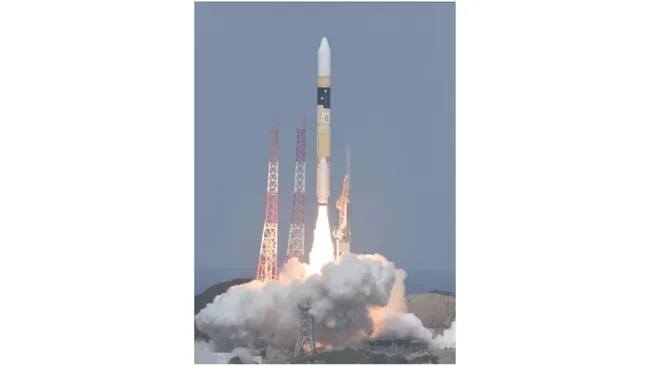
    The IGS-Radar 8 satellite lifted off at 1:24 a.m. ET on Thursday (September 26).

    The rocket deployed the satellite as planned, according to Mitsubishi Heavy Industries, which builds and operates the H-2A.

    According to NextSpaceflight.com, IGS-Radar 8 is headed to sun-synchronous orbit (SSO), a polar path in which satellites cruise over patches of Earth at the same local solar time each day. SSOs are common destinations for spy and weather satellites, because they provide consistent lighting conditions over time.

    IGS-Radar 8 will be operated by Japan’s Cabinet Satellite Information Center, like other members of the IGS (“Information Gathering System”) fleet. As its name suggests, the spacecraft will study Earth in radar light, collecting data for intelligence purposes and for natural-disaster monitoring.

    The IGS fleet of satellites includes both a radar and an optical line. Indeed, the most recent H-2A launch, which occurred this past January, sent the IGS-Optical 8 spy satellite to SSO.

    Mitsubishi Heavy Industries built and operates the H-2A, which debuted in 2001. The 174-foot-tall (53 meters) rocket now has 49 missions under its belt, all of them successful except one; it failed during the November 2003 launch of the IGS 2 satellite.

    The end is near for the workhorse H-2A, however. It will be retired after its 50th launch, which could occur before the end of the year. The H-2A will be replaced by the new H3, which has launched three times to date, most recently on June 30.

  • Cosmic Campfire – DEM L 190

    Cosmic Campfire – DEM L 190

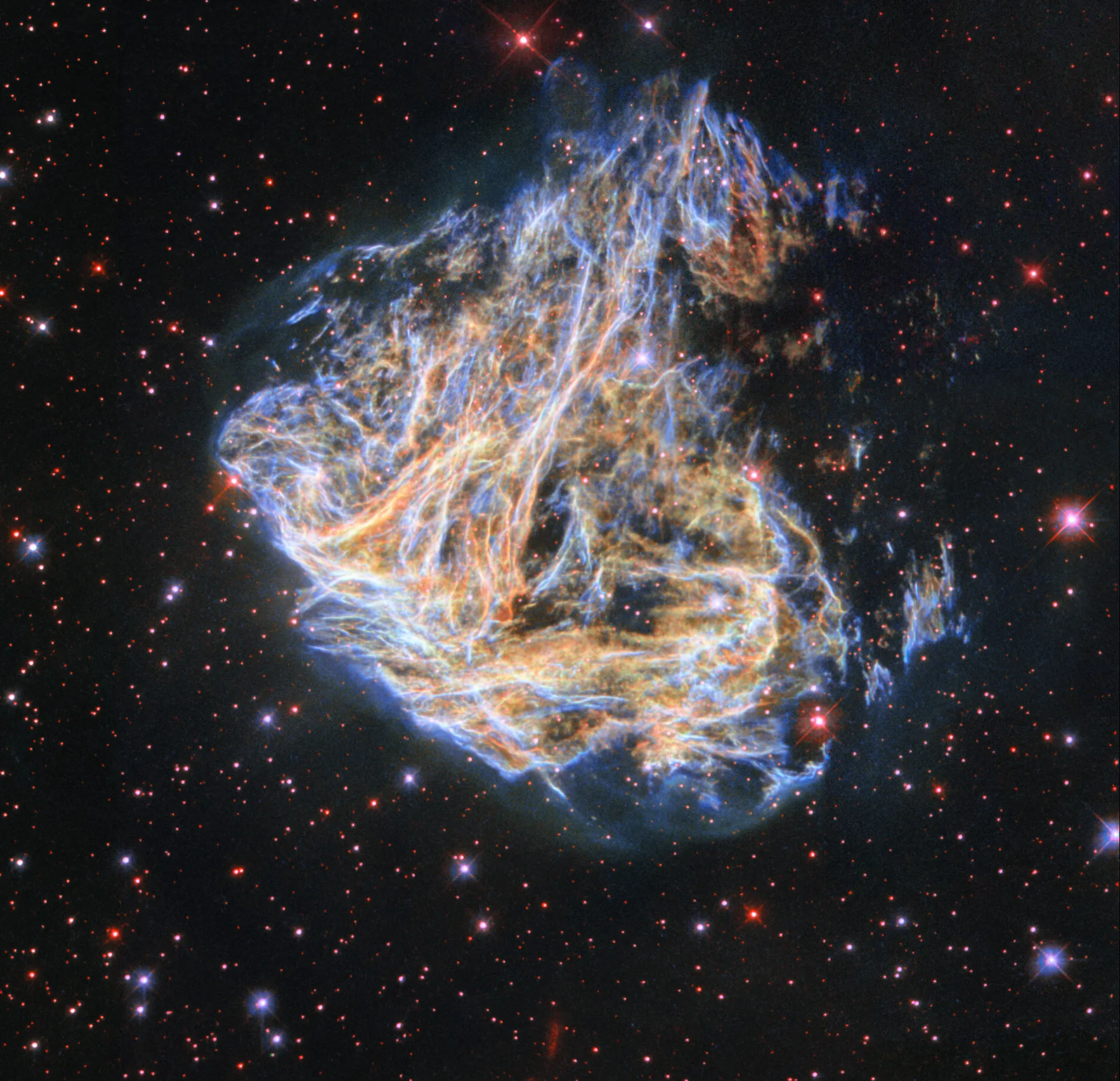
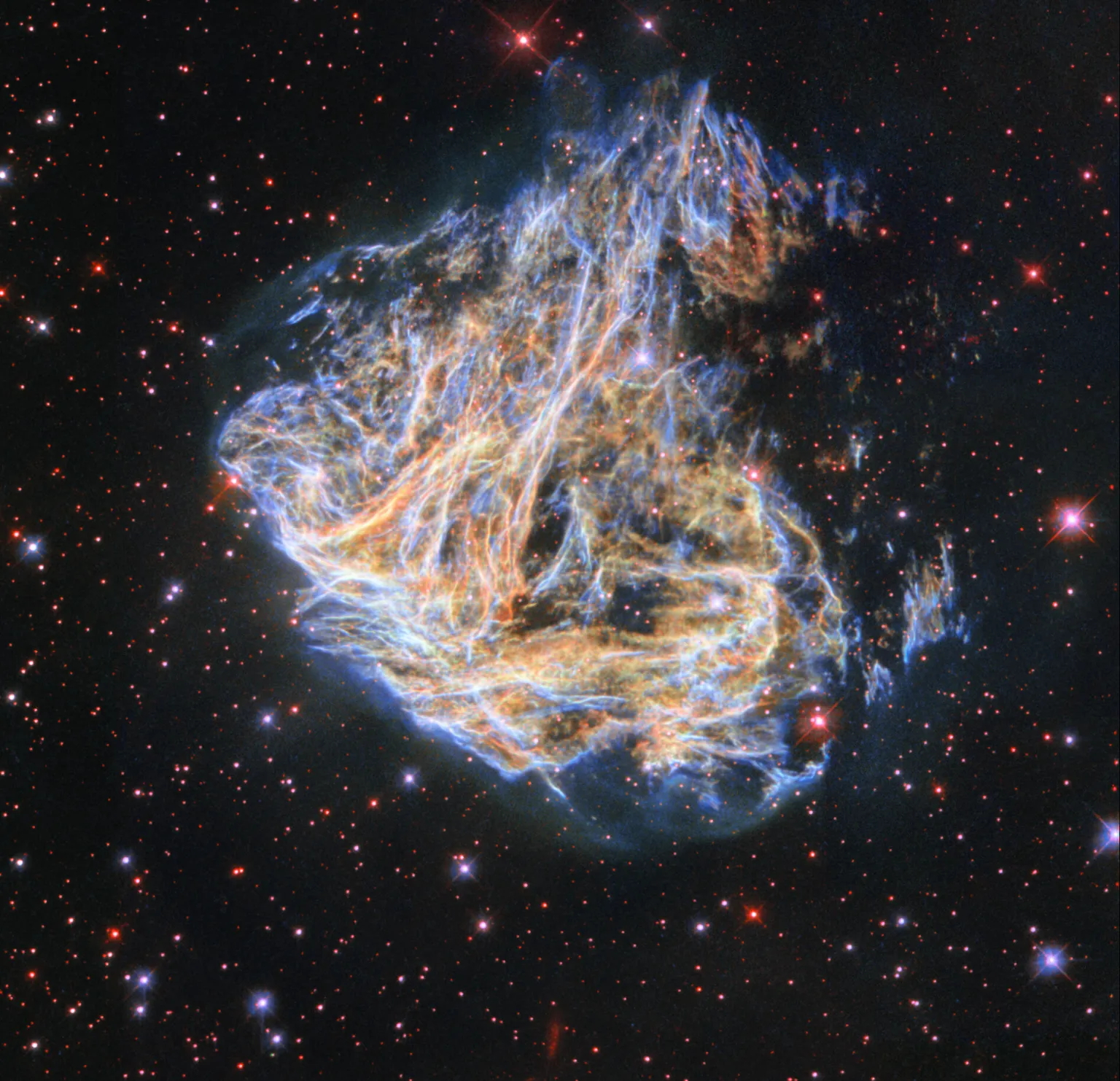
    This enthralling image of the supernova remnant DEM L 190, captured by the Hubble Space Telescope, provides a glimpse into the cataclysmic death of a massive star in the Large Magellanic Cloud, the Milky Way’s small galactic neighbour. Located approximately 160,000 light-years away from Earth in the constellation Dorado, DEM L 190, also known as LMC N49, is one of the brightest supernova remnants in the Large Magellanic Cloud.

    The delicate filaments of the remnant, which resemble puffs of smoke and sparks from a campfire, are layers of debris from the stellar explosion. These filaments, along with other materials from the blast, will eventually contribute to the formation of a new generation of stars.

    Astronomers studied DEM L 190 to understand the interaction between the supernova remnant and the interstellar medium. The intricate structure houses a powerful, rapidly spinning neutron star known as a magnetar. This exotic object undergoes episodes of gamma-ray emissions and is classified as a “soft gamma-ray repeater,” referring to its emission of photons with lower energy than typical gamma-ray bursts. The neutron star also emits X-rays with energies slightly less than those of soft gamma rays.

    The stunning image is a composite of data from two different astronomical projects using Hubble Space Telescope’s Wide Field and Planetary Camera 2 (WFPC2).

    Source: NASA

    Image Credit: ESA/Hubble & NASA, S. Kulkarni, Y. Chu

  • RECOLOURING the UNIVERSE

    RECOLOURING the UNIVERSE

    Pencil Code: Colour, Astronomy and Coding

    Using data from NASA’s Chandra X-ray Observatory and other satellites on exploded stars, star-forming regions, and black holes, you’ll learn basic coding. By following the video tutorials below, you will see just how integral coding is in the pursuit of learning about our Universe. It’s an example of the exciting ways that computer science is both part of routine tasks in our everyday lives and part of the exciting quest to explore the cosmos.

    Launch the coding activity now or start with the resources below for background information, facilitator guides, video tutorials and student examples.

    Launch the Coding Activities

    Grades 4-12 students with no prior coding experience can learn how to use computers to create images and understand astronomical data. Participants learn basic coding starting with familiar objects and simple concepts such as shape and colour, graduating to astronomical objects. Following a scaffolded set of activities, and working with data from NASA orbiting telescopes on sources from exploded stars to star-forming regions, to galaxies, to black holes, participants can experience real world application of science, technology and even art.

    Note: This activity can take from 40-75 minutes, depending on the total number of students, the length of time allotted per step, etc.

  • Starliner’s Troubled Thrusters to be Test-Fired on its Return to Earth

    Starliner’s Troubled Thrusters to be Test-Fired on its Return to Earth

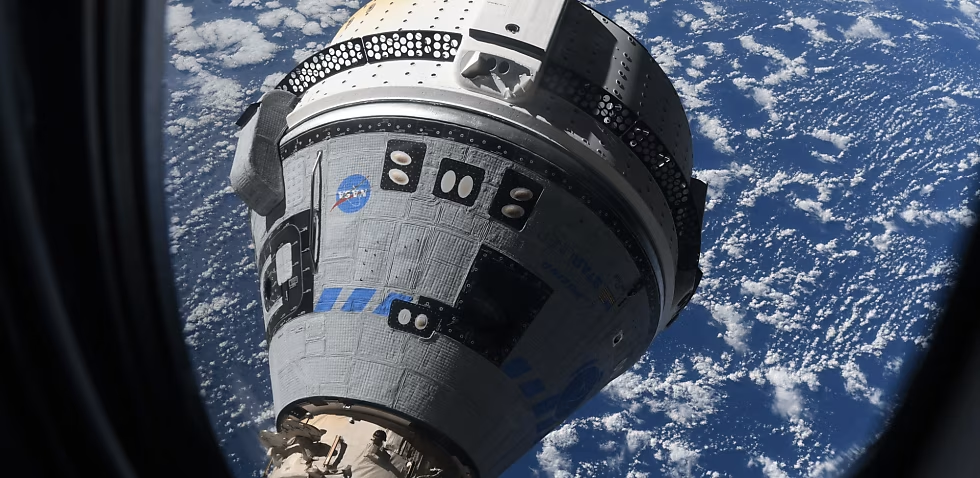
    NASA and Boeing are planning to test-fire the troubled thrusters of the CST-100 Starliner spacecraft before it returns to Earth.

    The Starliner, which has been docked at the International Space Station (ISS) since June 2023, has faced issues with its reaction control system (RCS) thrusters, including some that malfunctioned during its approach to the ISS.

    Ground tests have identified potential causes, such as higher temperatures causing oxidizer to vaporize and reduce thrust. Engineers will conduct a series of thruster tests while the spacecraft remains docked, excluding one malfunctioning thruster.

    The space agency said on Wednesday September 04, the tests would be short pulses lasting just 0.1 seconds and could involve some of the aft thrusters that experienced problems on the journey to the International Space Station (ISS).

    Steve Stich, NASA commercial crew program manager, explained that the thrusters’ test-firings would help the teams “continue to learn.” He continued to state that:

    “We really want to see how the thrusters perform and what the thrust levels exactly are after we undock and fire them for a little bit. We have been entirely focused this summer on understanding what is happening on orbit, trying to decide if we could bring the crew back or not. What we need to do now is lay out the overall plan, which we have not had time to do.”

    NASA also revealed that Starliner is now due to have a faster departure – or “breakout burn” – from the ISS because it is not carrying astronauts.

    “Without the crew on board, able to take manual control if needed, there’s just a lot less variables that we need to account for when we do the breakout burn and allows us to get the vehicle on a trajectory home that much sooner,” Stich said.

    Over the last two months, teams on Earth have been trying to duplicate the loss of performance in the thrusters, with researchers concluding that a Teflon seal had heated and expanded, which constrained the flow of oxidiser.

    However, NASA finally concluded there was still “too much uncertainty” in predicting how the thruster would perform after undocking, and instead opted to send the spacecraft back without crew.

    In a boost to Boeing though, Bill Nelson, NASA’s administrator, attempted to downplay criticism of the aerospace giant by arguing spaceflight is risky “even at its routine” and a test flight “by nature is neither safe nor routine”.

    “So, the decision to keep Butch and Suni aboard the ISS and bring the Boeing Starliner home uncrewed is a result of a commitment to safety. Safety is our North Star of what we are trying to do in a very hostile environment, in which if you make a mistake, it’s very unforgiving.”

    The current Starliner mission is the final test flight before NASA certifies the vehicle for regular operational missions.

    Source: NASA / Boeing

    Image: NASA / Boeing Starliner Spacecraft docked at the International Space Station.

  • Andromeda Galaxy

    Andromeda Galaxy

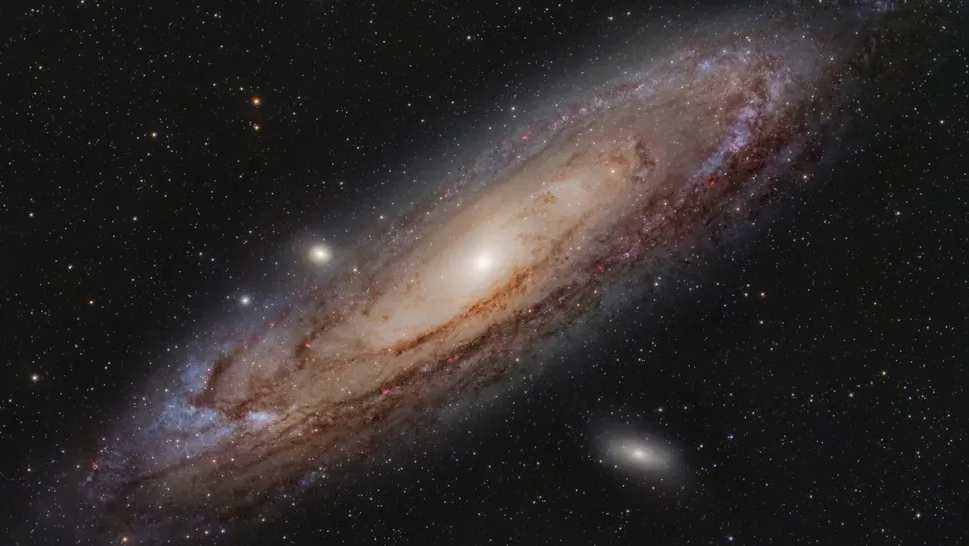
    The Andromeda Galaxy, also called Messier 31 or M31, is the nearest major galaxy to the Milky Way.

    It is 2.5 million light years away from Earth and is the other major member of the Local Group, our local collection of galaxies.

    Like the Milky Way, it is a barred spiral galaxy, so-called for the bar-like structure formed by the stars in its centre.


    Andromeda is about 260,000 light-years wide, according to NASA, making it the largest galaxy in the Local Group. However, its mass is comparable to or even less than that of the Milky Way, according to NASA JPL

    Scientists think the galaxy could be anywhere from 5 and 10 billion years old. However, it may not have existed in its current form until two or three billion years ago, when two smaller galaxies orbiting each other merged to form the current Andromeda Galaxy, according to a 2018 study.

    Can I see Andromeda?

    Andromeda is visible to the naked eye but only when viewed in dark skies and ideally on a moonless night. In many places, it is visible the entire year for at least part of the night but is highest in the sky and therefore easiest to spot in August and September, according to EarthSky. There are several ways to find Andromeda. One of the easiest is to locate the constellation Cassiopeia, which forms a kind of M or W shape in the sky. The lowest point of the W is the star Schedar, which points directly at Andromeda.

    Using a high-powered telescope in dark skies, it is also possible to observe some of the star clusters within the galaxy, such as the bright cluster Mayall II, also called Globular One or G1. This cluster is so bright that some researchers think it is the remnant of the core of a dwarf galaxy that merged with Andromeda in the distant past.

    What will happen when we hit the Andromeda galaxy?

    When the Milky Way and Andromeda merge in about 4.5 billion years, they will form a huge elliptical galaxy. Chances are that our solar system will be unaffected. We might be pulled away from the centre of the galaxy, or we might be totally ejected from it. Stars are so far apart that any sort of collision is extremely unlikely. However, it is almost certain that the increasing luminosity of our sun will have caused Earth to become inhospitable to all multicellular life by this point, so we will not be around to find out.

    Is Andromeda bigger than the Milky Way?

    Andromeda is larger than the Milky Way in terms of the distance it extends. However, the two galaxies are comparable in mass, and it is hard to say which one is more massive.

    Colliding galaxies:

    Andromeda and the Milky Way are slowly drifting towards each other, leading scientists to conclude that they will collide about 4.5 billion years from now, according to a 2019 study. The two galaxies will form a giant elliptical, or oval, galaxy, according to NASA.

    It is not clear what might happen to our planet and solar system during this merger. Scientists think we might be swept about much further away from the core of the Milky Way, according to NASA, or be completely ejected from our galaxy. However, neither one of these things would impact our solar system.


    Unfortunately (or fortunately) for us, we will not be around to find out what happens. By around a billion years from now, the sun’s increasing luminosity is predicted to have disrupted life on Earth so thoroughly that only single-celled organisms will be left.


    A possible exoplanet:

    In 1999, scientists noticed a minute change in Andromeda known as a microlensing event, which they called PA-99-N2. Gravitational lensing happens when something extremely massive, like a large galaxy, bends the light of a far more distant background object behind it, sometimes creating multiple distorted images of that object. With microlensing, a smaller object, like a star or planet, causes this type of distortion. The distortion of light causes the background source to become temporarily brighter, according to the Planetary Society.

    One explanation for this event is that the background object was a red giant star in Andromeda, and the lensing object was another star in the galaxy, with a planet orbiting it. Scientists think this star has a planet because of the pattern of the brightening during the event. If this planet exists, it would be the first exoplanet discovered in another galaxy. The planet may be around 6.34 times the mass of Jupiter, according to a 2012 study.

    Andromeda and the Great Debate

    In the 1920s, the distant galaxy became part of the Great Debate between American astronomers Harlow Shapley and Heber Curtis. At the time, astronomers thought the Milky Way composed the whole universe, and the strange patches such as Andromeda (known as “nebulas” at the time) lay inside of them. Curtis had spotted various novas in Andromeda and argued it was not a “nebula” but instead that it was a separate galaxy.

    The discussion was not concluded until 1925 when Edwin Hubble identified a special kind of star known as a Cepheid variable — a star whose characteristics allow for precise measurements of distance — within Andromeda. Because Shapley had previously determined that the Milky Way was only 100,000 light-years across, Hubble’s calculations revealed that the fuzzy patch was too far away to lie within the Milky Way.

    What are some major similarities and differences between Andromeda and our Milky Way galaxy?

    Both are intermediate-type spirals, with 3-D central bars (not very strong ones). M31 is often reported as more massive. Both central black holes are relatively inactive. M31 is even less active than the Milky Way at least at present.

    M31 probably has more globular clusters. Both have families of a dozen or more dwarf galaxies around them, the Milky Way’s dwarf galaxies are better inventoried than M31 because they’re easier to observe.

    How similar would they look if we could see both from the outside? 

    Not quite sure, because we cannot see our own from outside!

    What are some ways we think Andromeda might have evolved and changed over time?

    The current understanding is that both the Milky Way and M31 (and large galaxies in general) have formed from mergers of a few smaller ones and ongoing accretion of dwarf galaxies.

    The evidence is streams of stars moving together in the Milky Way that are left from such dwarfs coming close and getting torn apart. As a result, there are lots of stars in the Milky Way that are older than the age of the fully assembled galaxy. Mergers still occur from time to time for both the Milky Way and M31. Both probably also have had their nuclei more active in the past when the central black holes experienced episodes of accreting gas and/or having a star come close enough to get torn apart (tidal disruption event) and fall into the black hole.

    Why do researchers think Andromeda will collide or merge with our galaxy?

    The two galaxies are moving toward each other now at about 100 km/sec and are about 685,000 parsecs apart, so some interaction is inevitable. Probably a glancing collision because the Milky Way and M31 are not aimed exactly straight at one another.

    How would our galaxy merge with Andromeda impact Earth and our solar system?

    Not predictable for certain (because there is some tiny probability of a near collision of the sun with an M31 star) but certainly fairly minor because the stars are so far apart compared to their sizes and the sizes of the main part of the solar system.

    Gas from the two galaxies will collide, forming a shockwave and very likely trigger an episode of star formation so that a few million years later, we would probably have lots more young, bright stars near enough to be naked-eye objects.

    Resources:

    1. NASA. “The Galaxy Next Door”. https://www.nasa.gov/image-article/galaxy-next-door/

    2. NASA Jet Propulsion Laboratory. “Cool, New Views of Andromeda Galaxy.” https://www.jpl.nasa.gov/news/cool-new-views-of-andromeda-galaxy

    3. Schindler, K. “Views From Mars Hill: Andromeda Galaxy,” Lowell Observatory. https://lowell.edu/views-from-mars-hill-andromeda-galaxy/

    4. Hammer F et al. “A 2–3 billion-year-old major merger paradigm for the Andromeda galaxy and its outskirts,” Monthly Notices of the Royal Astronomical Society. https://academic.oup.com/mnras/article/475/2/2754/4839413

    5. McClure, B. “Andromeda galaxy: All you need to know,” EarthSky. https://earthsky.org/clusters-nebulae-galaxies/andromeda-galaxy-closest-spiral-to-milky-way/

    6. Refreshing Views. “Star Clusters in Another Galaxy”. https://www.youtube.com/watch

    7. Ma J et al. “Structural parameters of Mayall II = G1 in M31,” Monthly Notices of the Royal Astronomical Society. https://academic.oup.com/mnras/article/376/4/1621/1014745

    8. van der Marel R et al. “First Gaia Dynamics of the Andromeda System: DR2 Proper Motions, Orbits, and Rotation of M31 and M33,” The Astrophysical Journal. https://iopscience.iop.org/article/10.3847/1538-4357/ab001b

    9. NASA Hubble Mission Team. “NASA’s Hubble Shows Milky Way is Destined for Head-On Collision.” https://science.nasa.gov/missions/hubble/nasas-hubble-shows-milky-way-is-destined-for-head-on-collision/


    10. Muir H. “Galactic merger to ‘evict’ Sun and Earth,” New Scientist. https://www.newscientist.com/article/dn11852-galactic-merger-to-evict-sun-and-earth/#.VDVdDvl_uVB

    11. O’Malley-James, Jack T et al. “Swansong biospheres II: the final signs of life on terrestrial planets near the end of their habitable lifetimes,” International Journal of Astrobiology. https://www.cambridge.org/core/journals/international-journal-of-astrobiology/article/abs/swansong-biospheres-ii-the-final-signs-of-life-on-terrestrial-planets-near-the-end-of-their-habitable-lifetimes/EC5E8031028203F2EA3866C170575922#

    12. The Planetary Society. “Space-Warping Planets: The Microlensing Method.” https://www.planetary.org/articles/space-warping-planets-the-microlensing-method

    13. Ingrosso, G et al. “Detection of exoplanets in M31 with Pixel-Lensing: The Event PA-99-N2 Case,” The Twelfth Marcel Grossmann Meeting. https://www.worldscientific.com/doi/abs/10.1142/9789814374552_0433


    Image #1: Image of the andromeda galaxy showing swirling arms of gas and dust with a bright centre. (Image credit: Westend61 via Getty Images)

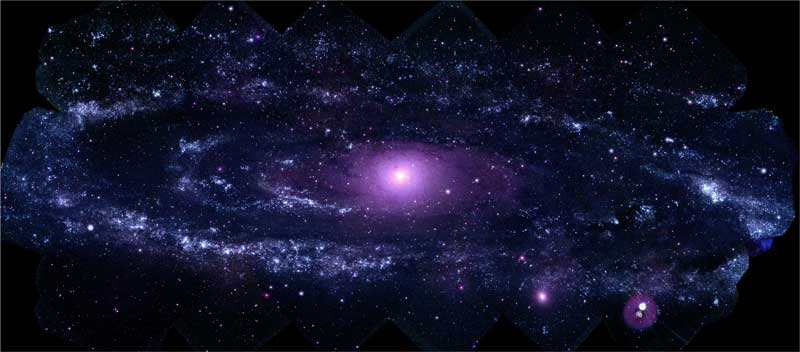
    Image #2: This mosaic of M31 merges 330 individual images taken by the Ultraviolet/Optical Telescope aboard NASA’s Swift spacecraft. It is the highest-resolution image of the galaxy ever recorded in the ultraviolet. The image shows a region 200,000 light-years wide and 100,000 light-years high (100 arcminutes by 50 arcminutes). (Image credit: NASA/Swift/Stefan Immler (GSFC) and Erin Grand (UMCP))

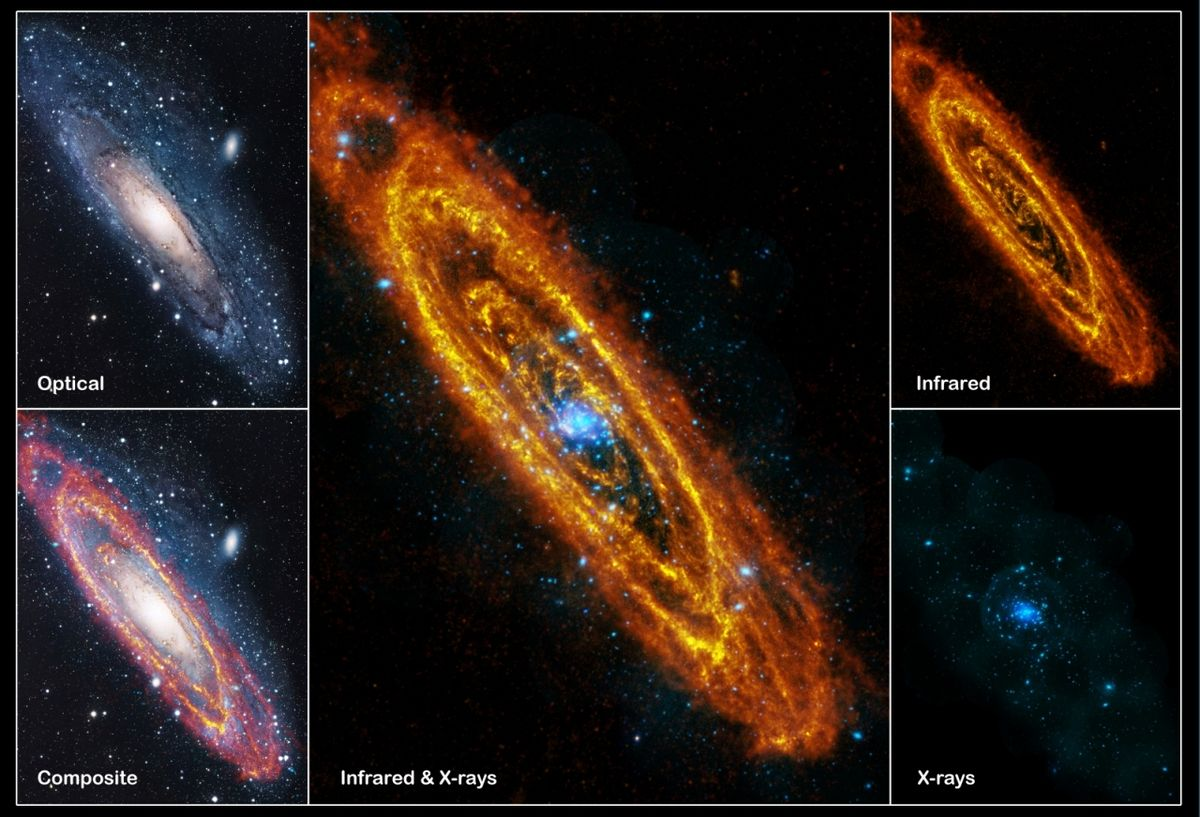
    Image #3: The Andromeda galaxy in the visible, infrared, and X-ray light spectrums, using data from the European Space Agency’s Herschel (infrared) and XMM-Newton (X-ray) observatories, as well as the optical image by Robert Gendler.  (Image credit: infrared: ESA/Herschel/PACS/SPIRE/J. Fritz, U. Gent; X-ray: ESA/XMM-Newton/EPIC/W. Pietsch, MPE; optical: R. Gendler)
  • Andromeda Constellation’s NGC 7640

    Andromeda Constellation’s NGC 7640

    The Andromeda Constellation is the 19th largest of the 88 constellations recognized by the International Astronomical Union (IAU) and should not be confused with our neighboring Andromeda Galaxy.

    The Andromeda Constellation consists of 16 stars visible in the northern sky. Named by ancient Greeks after the mythological Andromeda princess, the constellation also contains the Andromeda Galaxy, the nearest full-fledged galaxy to our own Milky Way.

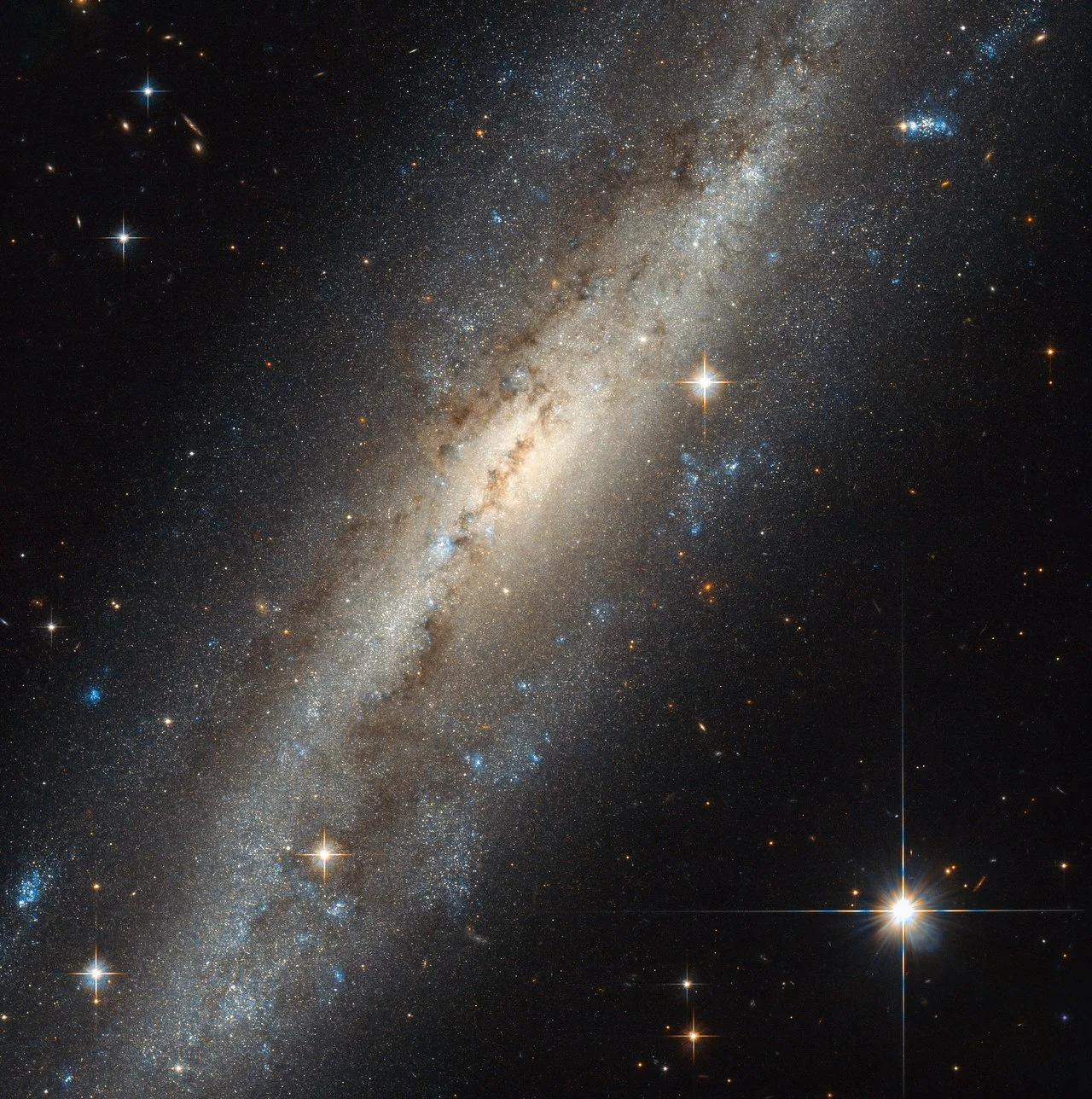
    The Andromeda constellation is home to the pictured galaxy known as NGC 7640.

    Many different classifications are used to identify galaxies by shape and structure — NGC 7640 is a barred spiral type. These are recognizable by their spiral arms, which fan out not from a circular core, but from an elongated bar cutting through the galaxy’s center. Our home galaxy, the Milky Way, is also a barred spiral galaxy.

    NGC 7640 might not look much like a spiral in this image, but this is due to the orientation of the galaxy with respect to Earth — or to Hubble, which acted as photographer in this case! We often do not see galaxies face on, which can make features such as spiral arms less obvious.

    There is evidence that NGC 7640 has experienced some kind of interaction in its past.

    Galaxies contain vast amounts of mass, and therefore affect one another via gravity. Sometimes these interactions can be mild, and sometimes hugely dramatic, with two or more colliding and merging into a new, bigger galaxy.

    Understanding the history of a galaxy, and what interactions it has experienced, helps astronomers to improve their understanding of how galaxies — and the stars within them — form.

    Image Credit: ESA / Hubble and NASA

  • Advanced data shed light on gravitational basins of attraction that shape the movement of galaxies

    Advanced data shed light on gravitational basins of attraction that shape the movement of galaxies

    by Hebrew University of Jerusalem

    September 27, 2024

    A new study has mapped out the gravitational basins of attraction in the local universe, offering fresh insights into the large-scale cosmic structures that shape the movement of galaxies. The study has been published in Nature Astronomy.

    Using advanced data from the Cosmicflows-4 compilation of distances and velocities of roughly 56,000 galaxies, the international research team applied cutting-edge algorithms to identify regions where gravity dominates, such as the Sloan Great Wall and the Shapley Supercluster.

    This research suggests that our Milky Way most probably resides within the larger Shapley basin, shifting our understanding of cosmic flows and the role of massive structures in shaping the universes evolution.

    A team of international researchers has taken a significant step forward in understanding the vast structure of the universe, identifying key gravitational regions known as basins of attraction.

    The research, led by Dr. Valade during his doctoral work under the supervision of Prof. Yehuda Hoffman from Hebrew University and Prof. Noam Libeskind from AIP Potsdam. The work also involved contributions from Dr. Pomarede from the University of Paris-Saclay, Dr. Pfeifer from AIP Potsdam, and Prof. Tully and Dr. Kourkchi from the University of Hawaii.


    Understanding the structure of the universe

    The study is based on the widely accepted Lambda Cold Dark Matter (ΛCDM) standard model of cosmology, which suggests that the universe’s large-scale structure emerged from quantum fluctuations during the early stages of cosmic inflation.

    These minute fluctuations in density evolved over time, forming the galaxies and clusters we observe today. As these density perturbations grew, they attracted surrounding matter, creating regions where gravitational potential minima, or “basins of attraction,” formed.

    Utilizing the latest data from the Cosmicflows-4 (CF4) compilation, the team employed a Hamiltonian Monte Carlo algorithm to reconstruct the large-scale structure of the universe up to a distance corresponding to roughly a billion light years. This method allowed the researchers to provide a probabilistic assessment of the universe’s gravitational domains, identifying the most significant basins of attraction that govern the movement of galaxies.

    Laniakea and Shapley basins of attraction

    Earlier catalogs had suggested that the Milky Way galaxy was part of a region called the Laniakea Supercluster. However, the new CF4 data offers a slightly different perspective, indicating that Laniakea might be part of the much larger Shapley basin of attraction, which encompasses an even greater volume of the local universe.

    Among the newly identified regions, the Sloan Great Wall stands out as the largest basin of attraction, with a volume of about half a billion cubic light years, more than twice the size of the Shapley basin, which was previously considered the largest. These findings provide an unprecedented look into the gravitational landscape of the local universe, offering new insights into how galaxies and cosmic structures evolve and interact over time.

    A leap forward in cosmological research

    This research offers a deeper understanding of the universe’s intricate gravitational dynamics and the forces that have shaped its structure. The identification of these basins of attraction is a significant advancement in cosmology, potentially reshaping our understanding of cosmic flows and large-scale structures.

    This research is important because it deepens our understanding of the large-scale structure of the universe and the gravitational forces that shape it. By mapping out the basins of attraction—regions where gravity pulls galaxies and matter—the study reveals how massive cosmic structures influence the movement and formation of galaxies over time.

    Understanding these dynamics not only helps us better grasp the universe’s past and its ongoing evolution, but also provides valuable insights into fundamental cosmological questions, such as the distribution of dark matter and the forces driving cosmic expansion. This knowledge has the potential to refine our models of the universe and guide future astronomical research.

    Image:

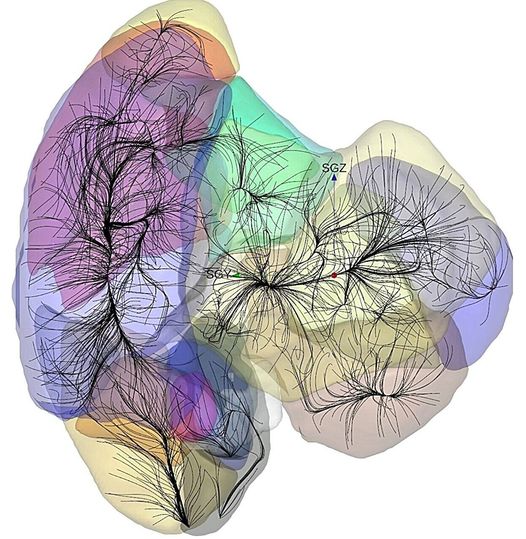
    Velocity streamlines within the reconstructed volume, with colored envelopes associated with the prominent nearby basins of attraction. The map and streamlines have been cropped to the region covered by Cosmicflows-4 data. The streamlines within a given basin converge onto the region of high concentration of galaxies. Credit: Daniel Pomarède

    Journal:

    Identification of basins of attraction in the local universe, Nature Astronomy (2024).

    DOI: 10.1038/s41550-024-02370-0