Category: Astronomy & the Universe

Stars, galaxies, constellations, black holes and telescopes

  • Horsehead Nebula (Euclid, Hubble, and Webb images)

    Horsehead Nebula (Euclid, Hubble, and Webb images)

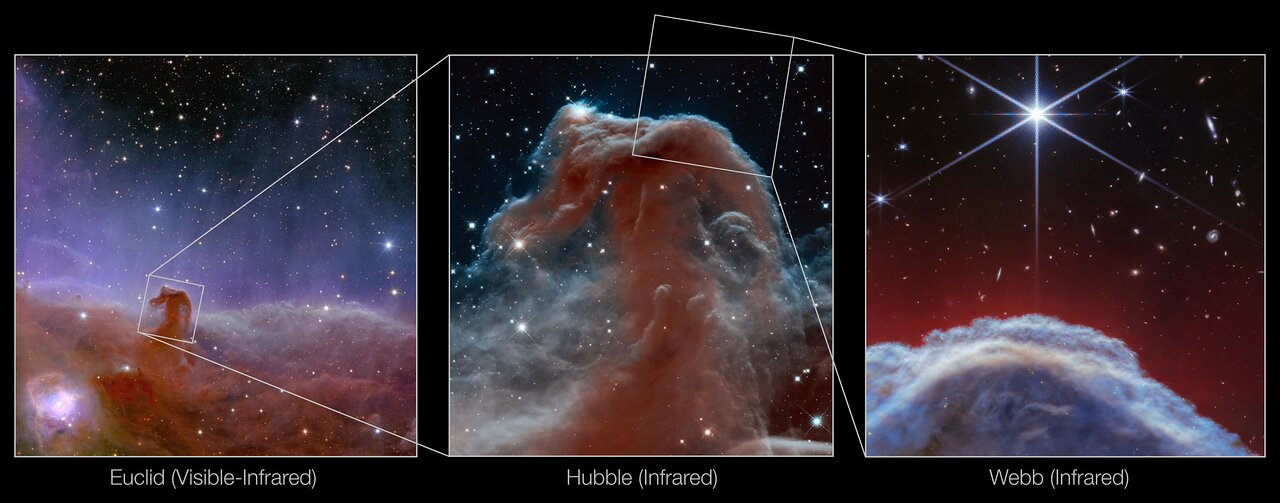
    This image showcases three views of one of the most distinctive objects in our skies, the Horsehead Nebula.

    This object resides in part of the sky in the constellation Orion (The Hunter), in the western side of the Orion B molecular cloud. Rising from turbulent waves of dust and gas is the Horsehead Nebula, otherwise known as Barnard 33, which resides roughly 1300 light-years away.

    The First Image (left):

    Released in November 2023, it features the Horsehead Nebula as seen by ESA’s Euclid telescope. Euclid captured this image of the Horsehead in about one hour, which showcases the mission’s ability to very quickly image an unprecedented area of the sky in high detail.

    The Second Image (middle):

    This image shows the NASA/ESA Hubble Space Telescope’s infrared view of the Horsehead Nebula, which was featured as the telescope’s 23rd anniversary image in 2013. This image captures plumes of gas in the infrared and reveals a beautiful, delicate structure that is normally obscured by dust.

    The Third Image (right): 

    The image features a new view of the Horsehead Nebula from the NASA/ESA/CSA James Webb Space Telescope’s NIRCam (Near-InfraRed Camera) instrument. It is the sharpest infrared image of the object to date, showing a part of the iconic nebula in a whole new light, and capturing its complexity with unprecedented spatial resolution.


    Image: A collage of three images of the Horsehead Nebula. In the left image labelled “Euclid (Visible-Infrared)”, the Nebula is seen amongst its surroundings. A small box around it connects to the second image labelled “Hubble (Infrared)”, where the Nebula is zoomed in on. A portion of the Nebula’s head has another box, which leads with a callout to the third image, labelled “Webb (Infrared)”, of that area.

  • NASA’s James Webb Space Telescope (JWST) – Quick Facts

    NASA’s James Webb Space Telescope (JWST) – Quick Facts

    The James Webb Space Telescope (JWST) is a cutting-edge space telescope developed by NASA in collaboration with the European Space Agency (ESA) and the Canadian Space Agency (CSA).

    It was launched on December 25, 2021, and is designed to be the successor to the Hubble Space Telescope. JWST is the most powerful space telescope ever built, and it’s designed to observe the universe in infrared wavelengths, which allows it to see farther back in time and space than previous telescopes.

    Key Features of the JWST:

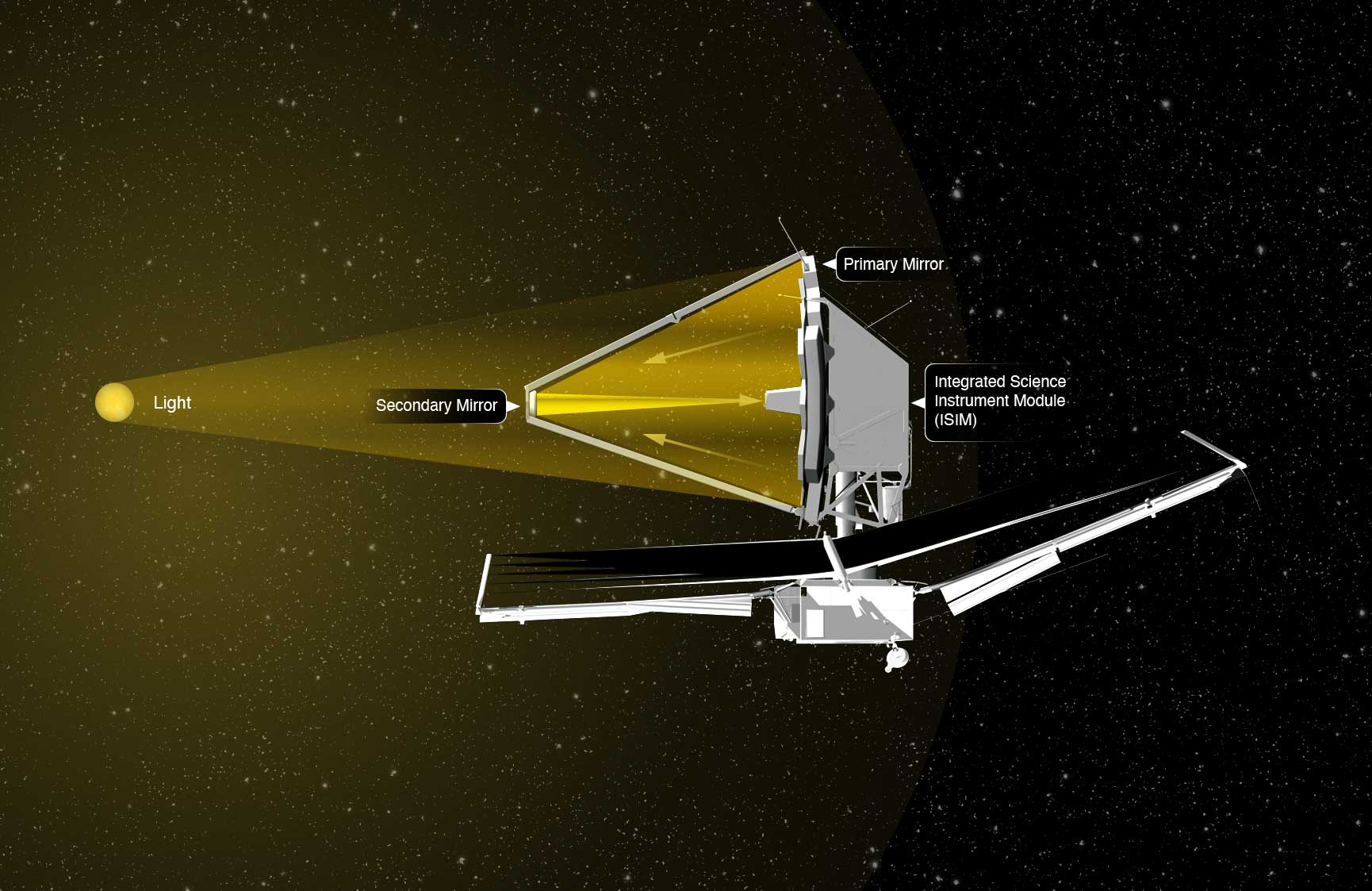
    • Primary Mirror: It has a large primary mirror that is 6.5 meters  in diameter, made up of 18 hexagonal segments. This allows it to collect more light and see distant objects with greater clarity.

    • Infrared Observation: JWST primarily observes in the infrared spectrum, which enables it to look through dust clouds and detect the faint light of distant stars and galaxies that formed just a few hundred million years after the Big Bang.

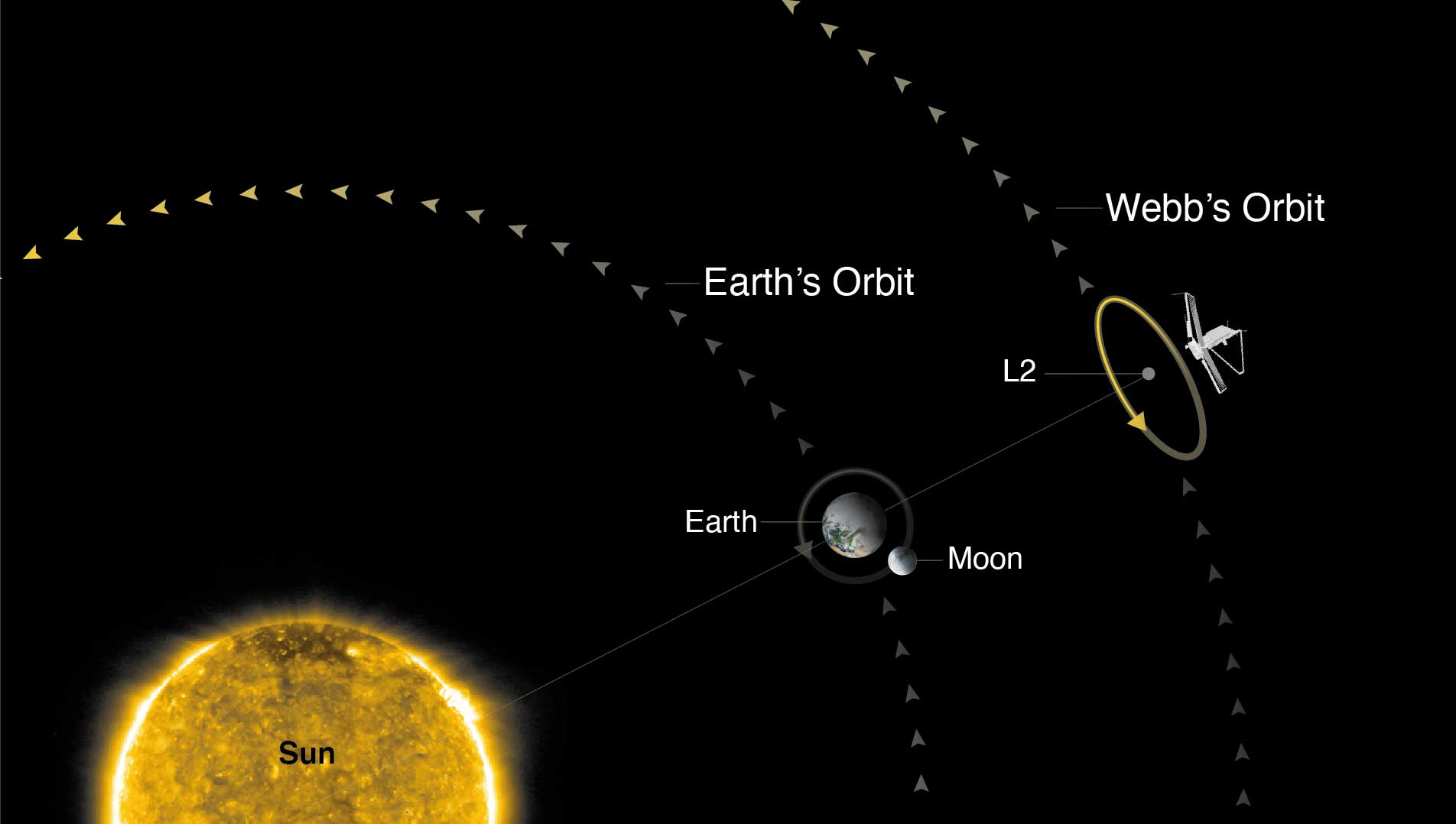
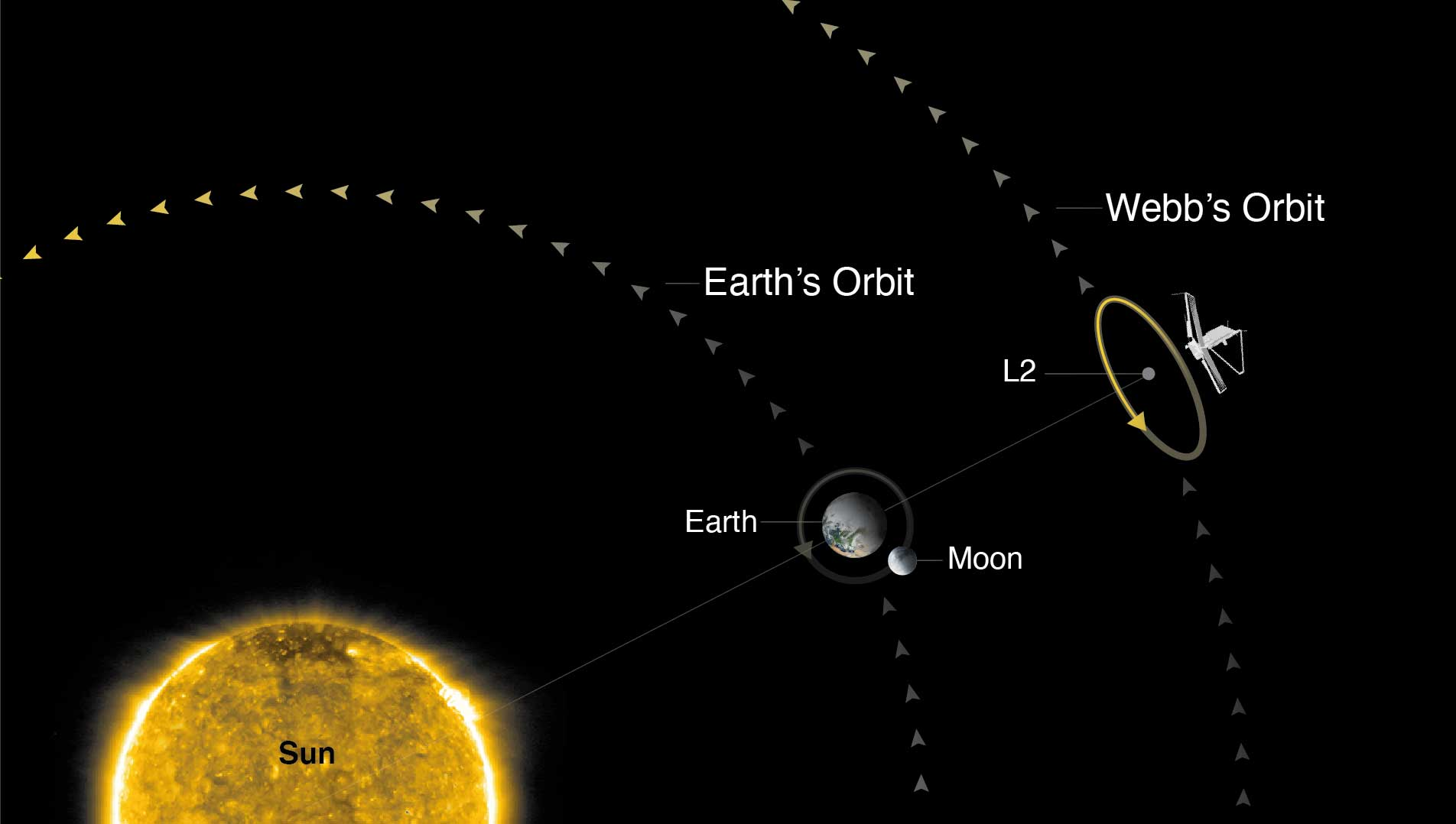
    • L2 Orbit: JWST is positioned at the second Lagrange point (L2), about 1.5 million kilometres from Earth. This location offers a stable environment for observation and helps the telescope stay cool.

    • Advanced Instruments: JWST is equipped with several state-of-the-art instruments, including:

      • NIRCam (Near-Infrared Camera)

      • NIRSpec (Near-Infrared Spectrograph)

      • MIRI (Mid-Infrared Instrument)

      • FGS/NIRISS (Fine Guidance Sensor/Near Infrared Imager and Slitless Spectrograph)

    Major Goals:

    1. Study the formation of stars and planetary systems.

    2. Observe distant galaxies and the early universe, probing the first billion years after the Big Bang.

    3. Explore the atmospheres of exoplanets to search for potential signs of life.

    JWST is revolutionizing our understanding of the universe, giving scientists the ability to explore deep cosmic history, distant planets, and the processes that shaped our solar system.

    Image #1: Webb will orbit the Sun near the second Sun-Earth Lagrange point (L2), which lies approximately 1.5 million kilometres from Earth on the far side of Earth from the Sun. Webb will not be located precisely at L2, but will move in a halo orbit around L2 as it orbits the Sun. In this orbit, Webb can maintain a safe distance from the bright light of the Sun, Earth, and Moon, while also maintaining its position relative to Earth. Credit: STScI.

    Image #2: Webb’s primary mirror intercepts red and infrared light traveling through space and reflects it onto a smaller secondary mirror. The secondary mirror then directs the light into the scientific instruments where it is recorded. Credit: STScI.

  • What is Astrophysics?

    What is Astrophysics?

    Astrophysics is a dynamic and interdisciplinary field within space science, that focuses on understanding the universe by applying the principles of physics and chemistry. It explores a wide range of cosmic phenomena and seeks to answer fundamental questions about the nature of the universe and our place within it.

    Key Areas of Astrophysics:

    • Stellar Astrophysics: Studies the life cycle of stars, from their formation in stellar nurseries to their evolution and eventual demise. This includes understanding different types of stars (like red dwarfs, giants, and supernovae) and phenomena such as pulsars and black holes.

    • Planetary Science: Investigates the formation, composition, and dynamics of planets, moons, and other bodies in our solar system and beyond. This includes studying exoplanets and their potential for supporting life.

    • Galactic Astrophysics: Examines the structure and dynamics of galaxies, including our own Milky Way. This area explores the formation and evolution of galaxies, the role of dark matter, and interactions between galaxies.

    • Cosmology: Focuses on the large-scale structure and evolution of the universe as a whole. This includes studying the Big Bang, cosmic inflation, dark energy, and the overall geometry and fate of the universe.

    • High-Energy Astrophysics: Investigates energetic phenomena such as gamma-ray bursts, black holes, and neutron stars. This field often involves understanding the behaviour of matter under extreme conditions.

    • Exoplanetary Science: Looks at planets outside our solar system, exploring their properties, atmospheres, and potential habitability. This involves techniques like transit photometry and radial velocity measurements.

    Relationship with Astronomy and Cosmology

    • Astronomy: Astronomy is often considered the observational counterpart to astrophysics. While astronomy focuses on the collection and analysis of data from telescopes and other instruments, astrophysics interprets these data using physical theories and models. Astronomy includes the study of the positions, motions, and properties of celestial objects.

    • Cosmology: Cosmology is a subfield of astrophysics that specifically deals with the large-scale structure and origin of the universe. It overlaps with astrophysics in areas like the study of the cosmic microwave background radiation and the expansion of the universe. Cosmologists use astrophysical models to understand the universe’s evolution from the Big Bang to its current state.


    Techniques and Tools

    1. Observational Techniques: Astrophysicists use various types of telescopes (optical, radio, infrared, X-ray, etc.) to gather data from different wavelengths. Observations are critical for studying celestial objects and phenomena.

    2. Theoretical Models: Developing and testing models is central to astrophysics. These models use principles from physics and chemistry to simulate and understand cosmic processes. Computational simulations play a significant role in predicting and interpreting astrophysical phenomena.

    3. Laboratory Experiments: In some cases, experiments on Earth can help understand cosmic processes. For example, particle accelerators and detectors can simulate conditions similar to those found in space.

    Notable Achievements and Questions

    • Black Holes: The study of black holes has led to significant insights into general relativity and quantum mechanics. The first image of a black hole’s event horizon, captured by the Event Horizon Telescope, was a landmark achievement in this field.

    • Dark Matter and Dark Energy: These mysterious components make up most of the universe’s mass-energy content. Astrophysics explores their effects and seeks to identify their nature.

    • Origins of the Universe: Understanding the Big Bang and the subsequent evolution of the universe remains a central question. Observations of the cosmic microwave background and large-scale structure provide clues to this early history.

    Astrophysics is a continually evolving field that bridges observations with theoretical understanding to unravel the universe’s mysteries. By integrating data from various sources and applying physical laws, astrophysicists strive to paint a comprehensive picture of the cosmos, from the tiniest particles to the largest structures.

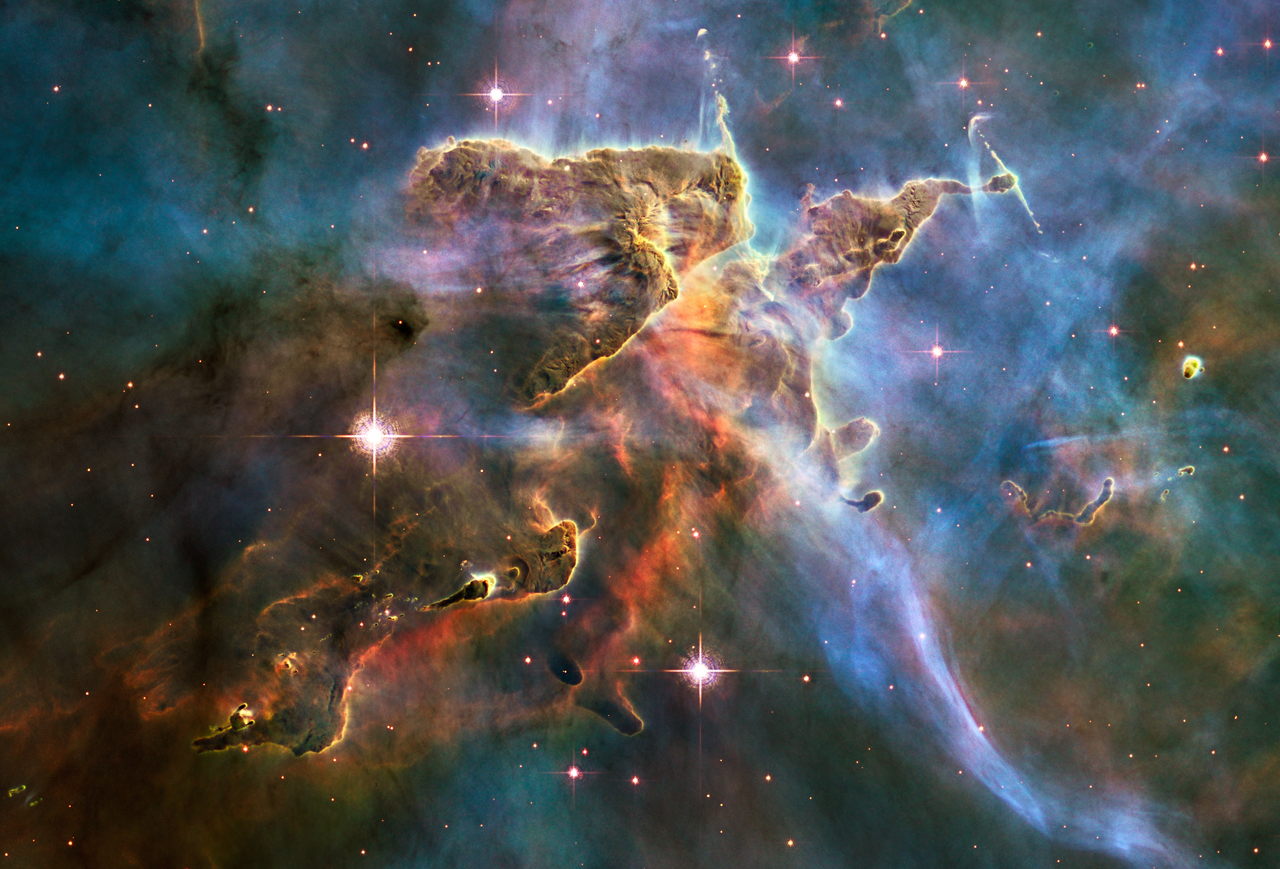
    Image Credit: Eta Carina NASA

  • RECOLOURING the UNIVERSE

    RECOLOURING the UNIVERSE

    Pencil Code: Colour, Astronomy and Coding

    Using data from NASA’s Chandra X-ray Observatory and other satellites on exploded stars, star-forming regions, and black holes, you’ll learn basic coding. By following the video tutorials below, you will see just how integral coding is in the pursuit of learning about our Universe. It’s an example of the exciting ways that computer science is both part of routine tasks in our everyday lives and part of the exciting quest to explore the cosmos.

    Launch the coding activity now or start with the resources below for background information, facilitator guides, video tutorials and student examples.

    Launch the Coding Activities

    Grades 4-12 students with no prior coding experience can learn how to use computers to create images and understand astronomical data. Participants learn basic coding starting with familiar objects and simple concepts such as shape and colour, graduating to astronomical objects. Following a scaffolded set of activities, and working with data from NASA orbiting telescopes on sources from exploded stars to star-forming regions, to galaxies, to black holes, participants can experience real world application of science, technology and even art.

    Note: This activity can take from 40-75 minutes, depending on the total number of students, the length of time allotted per step, etc.

  • What is the Andromeda Constellation?

    What is the Andromeda Constellation?

    The Andromeda constellation consists of 16 stars visible in the northern sky. Named by ancient Greeks after the mythological Andromeda princess, the constellation contains the Andromeda Galaxy, the nearest full-fledged galaxy to our own Milky Way.

    Andromeda is one of 48 constellations described by the Ancient Greek astronomer Claudius Ptolemy in 150 AD in his famous work “The Almagest.”

    Ptolemy’s list was the first official description of constellations, although these stellar groupings had been known to ancient Greeks, Babylonians, Egyptians and other cultures, who frequently saw them as embodiments of their mythical figures.

    Andromeda is one of the largest of Ptolemy’s constellations.

    Another 40 constellations were added to Ptolemy’s tally over the centuries. Many of these additions reside in the southern sky, which was not visible to Ptolemy, who spent most of his life in Egypt.

    Today, Andromeda is the 19th largest of the 88 constellations recognized by the International Astronomical Union.

    How to find the Andromeda Constellation

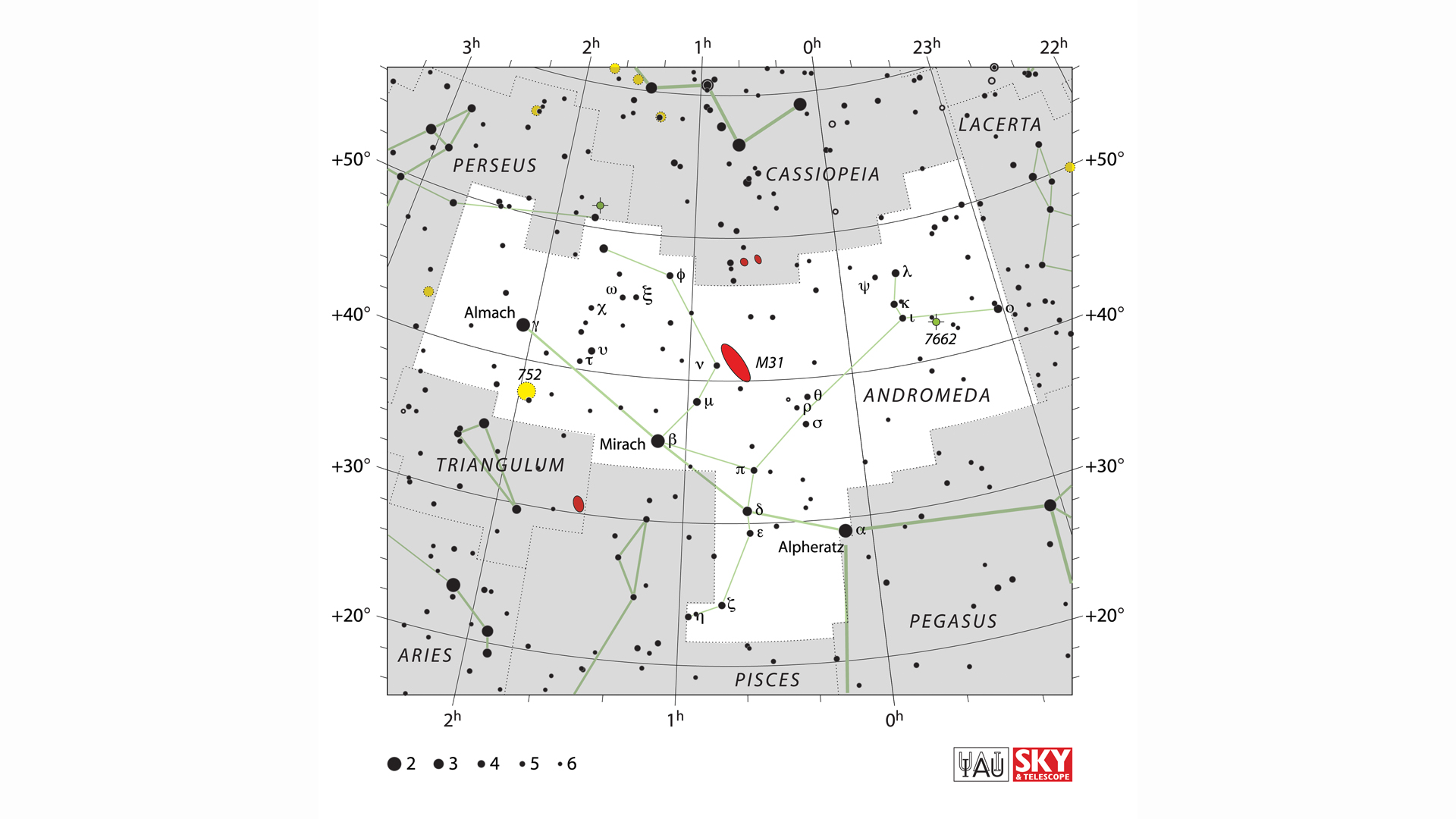
    Andromeda is part of a big prominent group of constellations named after mythological figures related to the Perseus and Andromeda myth. The pronounced W-shaped Cassiopeia constellation points directly at Andromeda.

    With a bit of imagination, you can see the constellation as a sprawled figure with its arms extended. The figure’s feet point in the direction of the Perseus constellation, right next to Cassiopeia. The figure’s “head” connects the constellation to the neighboring square of Pegasus.

    The Andromeda Myth

    In ancient Greek mythology, Andromeda was a beautiful daughter of the king Cepheus and queen Cassiopeia. When her mother bragged that Andromeda was better-looking than the famously beautiful Nereid sea nymphs, the sea god Poseidon sent his pet sea monster Cetus to destroy Cepheus’ kingdom.

    It was said, however, that sacrificing Andromeda could save the country and its people. So, the loving parents had their daughter chained to a rock by the sea, so that the sea monster could get her easily. Fortunately, the charming prince Perseus flew past on his winged horse Pegasus and fell in love with Andromeda’s beauty. He killed Cetus and married Andromeda. The two lived happily ever after.

    Stars of the Andromeda Constellation

    The Andromeda Constellation contains nine main named stars, according to Constellation Guide. Three of these stars are brighter than magnitude 3.00, which puts them into the top 100 brightest stars in the sky.

    In addition to the visible stars, one can find many intriguing objects within the Andromeda constellation that are only visible with telescopes or binoculars. The most famous one of these is the Andromeda Galaxy, the closest full-fledged galaxy to the Milky Way. Andromeda is currently about 2.5 million light-years from the Milky Way, and the two galaxies are on a collision course; a few billion years from now, they will smash into each other.

    • Alpheratz (Alpha Andromeda)

      • The brightest star in the Andromeda Constellation is Alpheratz, also called Alpha Andromedae. Alpheratz is essentially Andromeda’s head, but it’s also part of the neighbouring square of Pegasus.

      • Astronomers know today that Alpheratz is located 97 light-years from Earth and is, in fact, a binary star, a system of two stars orbiting a common centre of mass. The bigger of those two stars has a unique chemical composition and is the brightest known star with high levels of mercury and manganese. A so-called subgiant, this star is 200 times brighter than the sun while being less than four times as massive.

      • The smaller star of the Alpheratz binary system is about 10 times as luminous as the sun and orbits the larger star every 97 days, according to the Constellation Guide.

    • Mirach

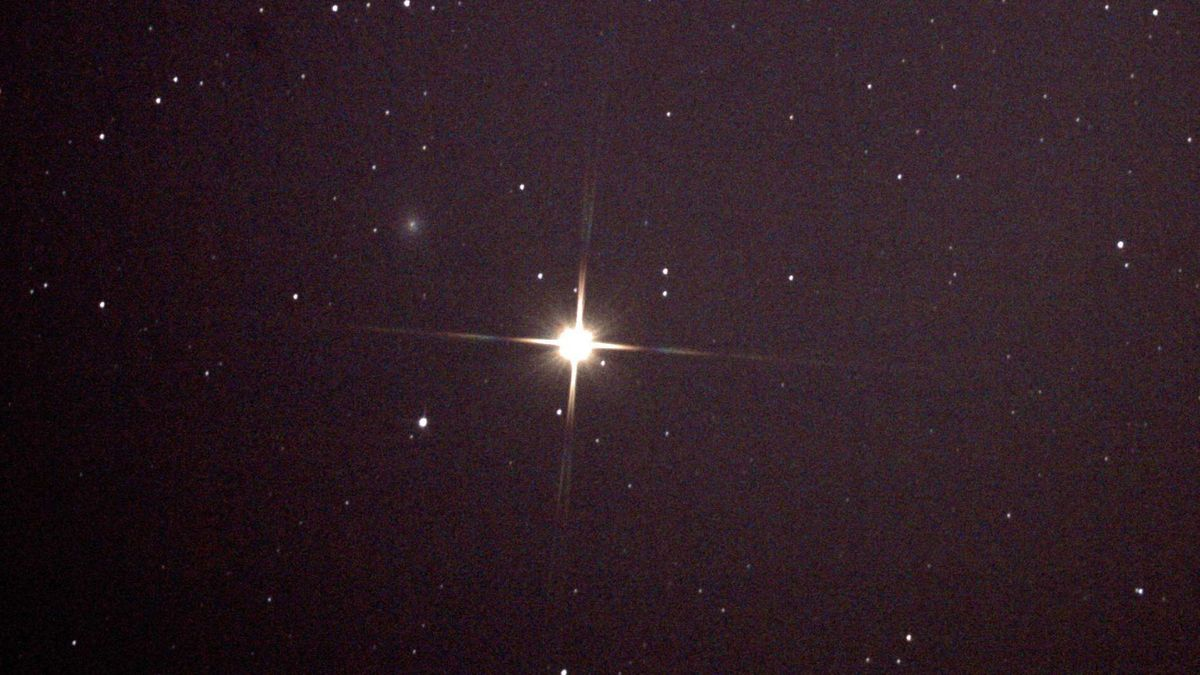
      • Mirach, also known as Beta Andromedae, is nearly as bright as Alpheratz and located about 200 light-years away from Earth. It is a giant star 1,900 times as bright as the sun, according to the Constellation Guide, and three to four times as massive.

      • Within the Andromeda Constellation, Mirach forms the chained figure’s left hip. Close to Mirach, astronomers can observe two distant dwarf galaxies located some 10 million light-years from Earth.

    • Almach

      • Almach, or Gamma Andramodae, is Andromeda’s foot. It is a multi-star system featuring a central giant orbited by a pair of white dwarfs. The third brightest star of the Andromeda Constellation, Almach is about 350 light-years away from Earth. The star’s central giant is 2,000 times more luminous than the sun.

    • Other stars in the Andromeda Constellation:

      • Other stars in the Andromeda Constellation are Delta Andromedae, Iota Andromedae, Upsilon Andromedae, Adhil (or Xi Andromedae) and Mu Andromedae.

    Andromeda Galaxy

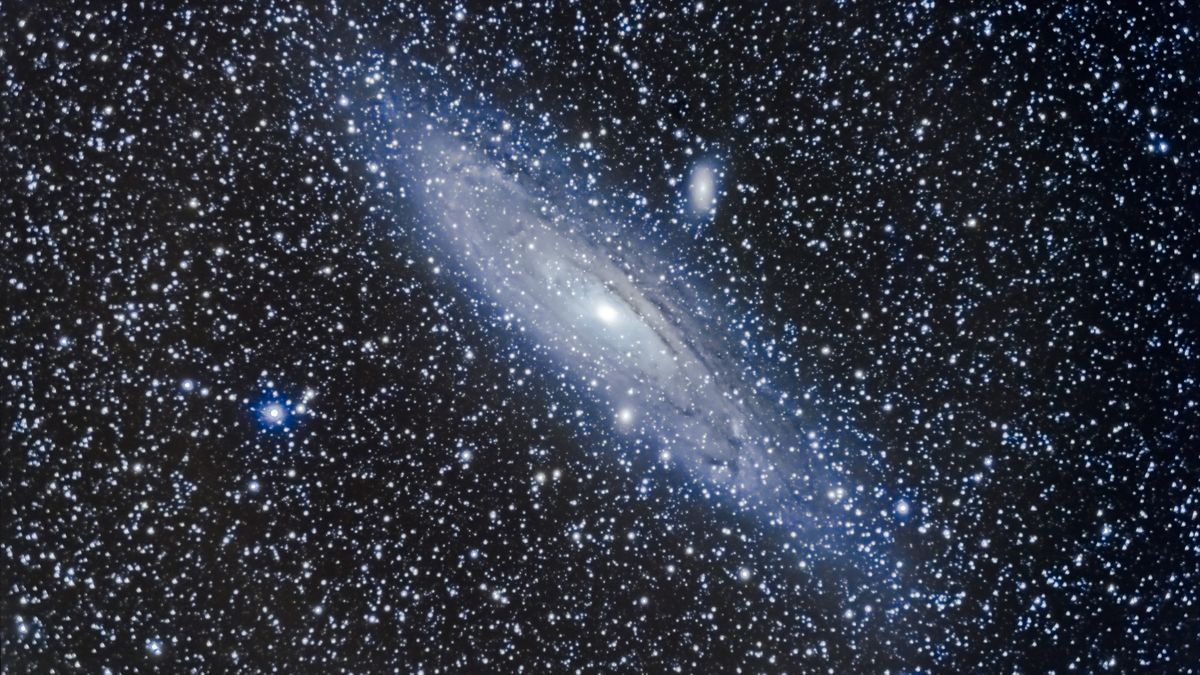
    The Andromeda Galaxy, the Milky Way’s nearest major galactic neighbour, can be found within the Andromeda Constellation. The galaxy, located some 2.5 million light-years away from Earth, is barely visible to the naked eye but can be found with binoculars.

    The Andromeda Galaxy, also known as M31, can be seen as a misty patch on the edge of the Andromeda Constellation to the right of the sprawled figure’s right hip, which is right next to the bright star Mirach. The right V shape of the Cassiopeia constellation points vaguely in the direction of the galaxy.

    Andromedids Meteor Shower

    The constellation also appeared to be the source of the Andromedids Meteor shower that used to occur every few years in November. But the stars of the constellation, obviously, had nothing to do with these shooting stars. The actual source of the space rocks was a trail of debris left behind by Comet Biela, and which Earth used to intersect every November. However, in recent decades, the once mesmerizing display nearly ceased, as our planet’s orbit moved out of the path of the cometary debris.

    References:

    1. IAU, Constellations. https://www.iau.org/public/themes/constellations/

    2. Swinburne University of Technology, Constellation. https://astronomy.swin.edu.au/cosmos/c/Constellation

    3. Britannica, Andromeda Constellation. https://www.britannica.com/place/Andromeda-constellation

    4. University of St. Andrews, Claudius Ptolemy.  https://mathshistory.st-andrews.ac.uk/Biographies/Ptolemy/

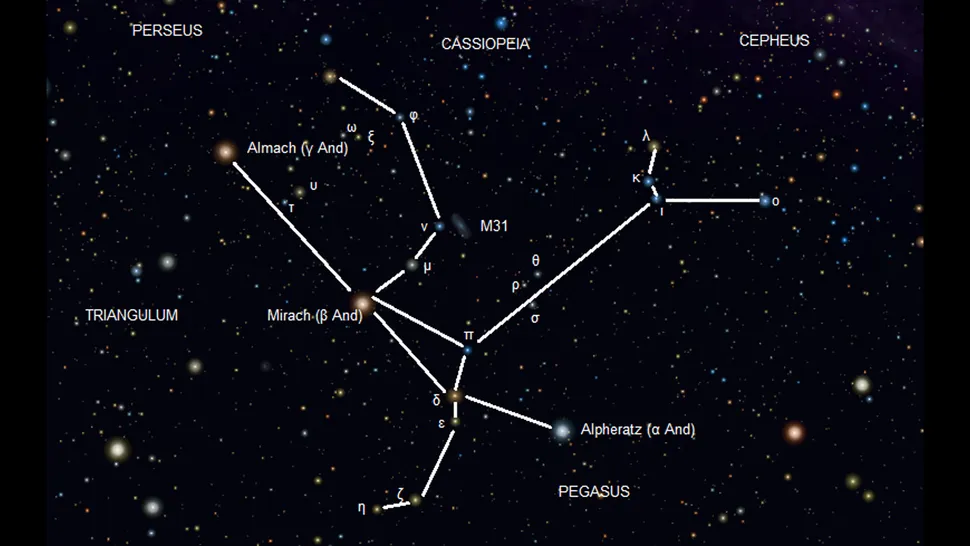
    Image #1: The Andromeda constellation with all Bayer-designated stars marked and the IAU figure drawn in. (Image credit: Wikimedia Commons/Keilana/Roberto Mura)

    Image #2: The position of the Andromeda constellation among the other constellations named after characters related to the Perseus myth. (Image credit: IAU)

    Image #3: Mirach is one of the brightest stars of the Andromeda constellation. (Image credit: Stub Mandrel)

    Image #4: The Andromeda Galaxy can be found on the edges of the Andromeda constellation. (Image credit: Alan Dyer /VW PICS/Universal Images Group via Getty Images)

  • What is the Messier Objects Catalog?

    What is the Messier Objects Catalog?

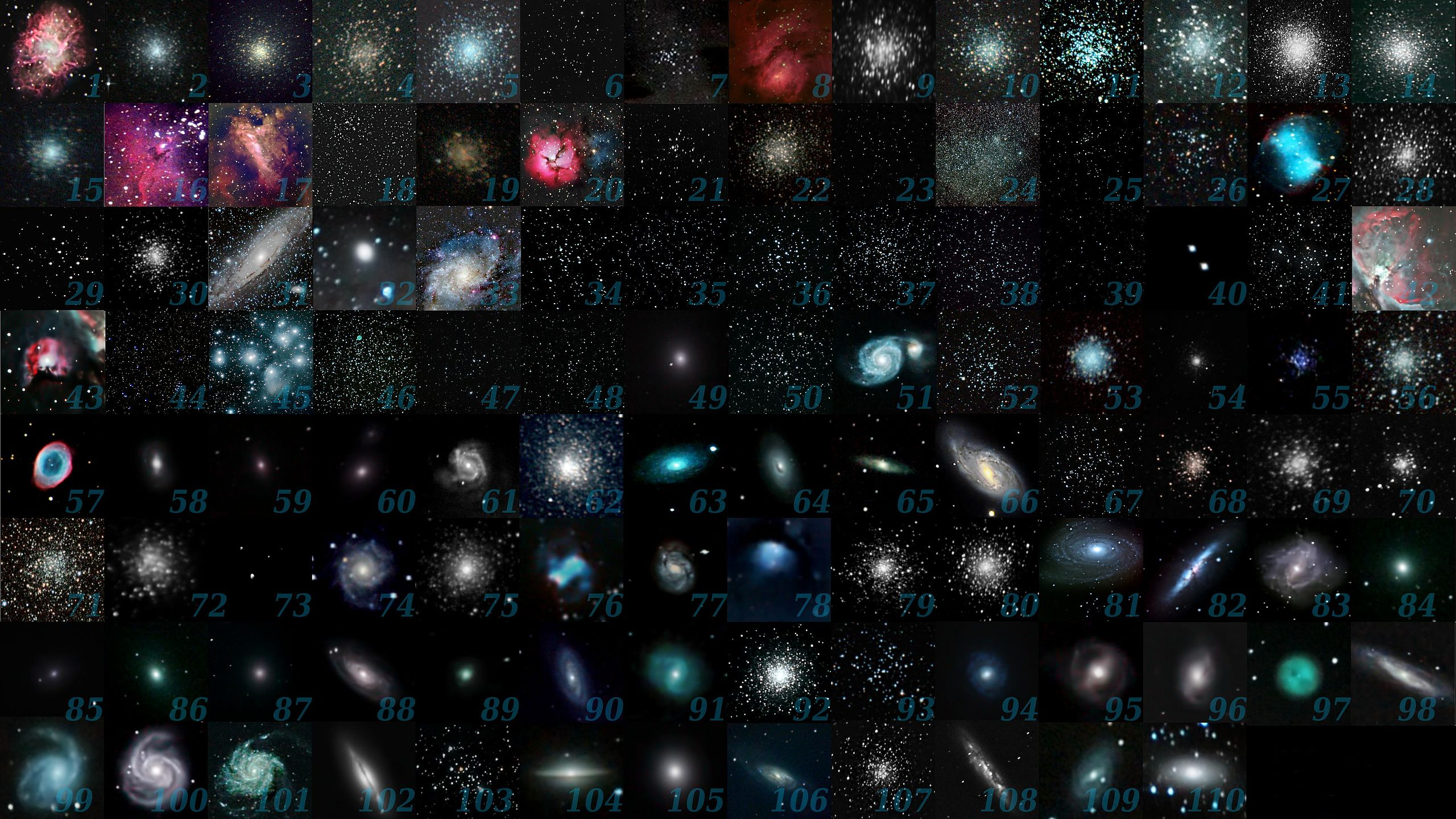
    Messier objects are a set of 110 astronomical objects cataloged by the French astronomer Charles Messier in the 18th century. Messier, who was primarily searching for comets, created this list to avoid confusing these static, diffuse objects with comets in the night sky.

    These objects include various types of deep-sky objects, such as galaxies, star clusters, and nebulae.

    Categories of Messier Objects:

    1. Galaxies: Large systems of stars, gas, and dust bound together by gravity. Examples include:

      • M31: The Andromeda Galaxy, the closest spiral galaxy to the Milky Way.

      • M87: A giant elliptical galaxy in the Virgo Cluster, known for housing a supermassive black hole.

    2. Star Clusters:

      • Globular Clusters: Dense, spherical collections of stars, typically old. Example: M13 (the Hercules Globular Cluster).

      • Open Clusters: Looser groups of younger stars. Example: M45, known as the Pleiades or “Seven Sisters.”

    3. Nebulae: Clouds of gas and dust where stars are born or remnants of stellar explosions. Examples:

      • M42: The Orion Nebula, a bright emission nebula and star-forming region.

      • M1: The Crab Nebula, the remnant of a supernova explosion.

    4. Planetary Nebulae: Shells of gas ejected by dying stars. Example:

      • M57: The Ring Nebula, a famous planetary nebula in the constellation Lyra.

    Significance:

    Messier’s catalog remains popular with astronomers and stargazers because many of these objects are bright and can be observed with small telescopes or even binoculars.

    The list includes some of the most beautiful and interesting objects in the sky, making it a favorite for amateur astronomers who attempt the Messier Marathon — an event where one tries to observe all 110 objects in a single night.

    Though Messier originally compiled the list to avoid distractions from his comet-hunting, it has become an important and widely used reference in observational astronomy.

    Messier Marathon:

    Since all the Messier objects are fairly bright, finding Messier objects is an ideal project for the beginning stargazer.

    Every year stargazers around the world take part in the Messier marathon. Participants use telescopes or binoculars and attempt to see as many Messier objects as possible throughout 12 continuous hours of darkness. In order to see them all, observations start at sunset and end at sunrise the following morning.

    A few Messier objects are hard to catch because they are only visible very close to the horizon.

    Image: All 110 Messier objects are shown here with their respective M numbers. Image via Wikipedia.

  • Andromeda Constellation’s NGC 7640

    Andromeda Constellation’s NGC 7640

    The Andromeda Constellation is the 19th largest of the 88 constellations recognized by the International Astronomical Union (IAU) and should not be confused with our neighboring Andromeda Galaxy.

    The Andromeda Constellation consists of 16 stars visible in the northern sky. Named by ancient Greeks after the mythological Andromeda princess, the constellation also contains the Andromeda Galaxy, the nearest full-fledged galaxy to our own Milky Way.

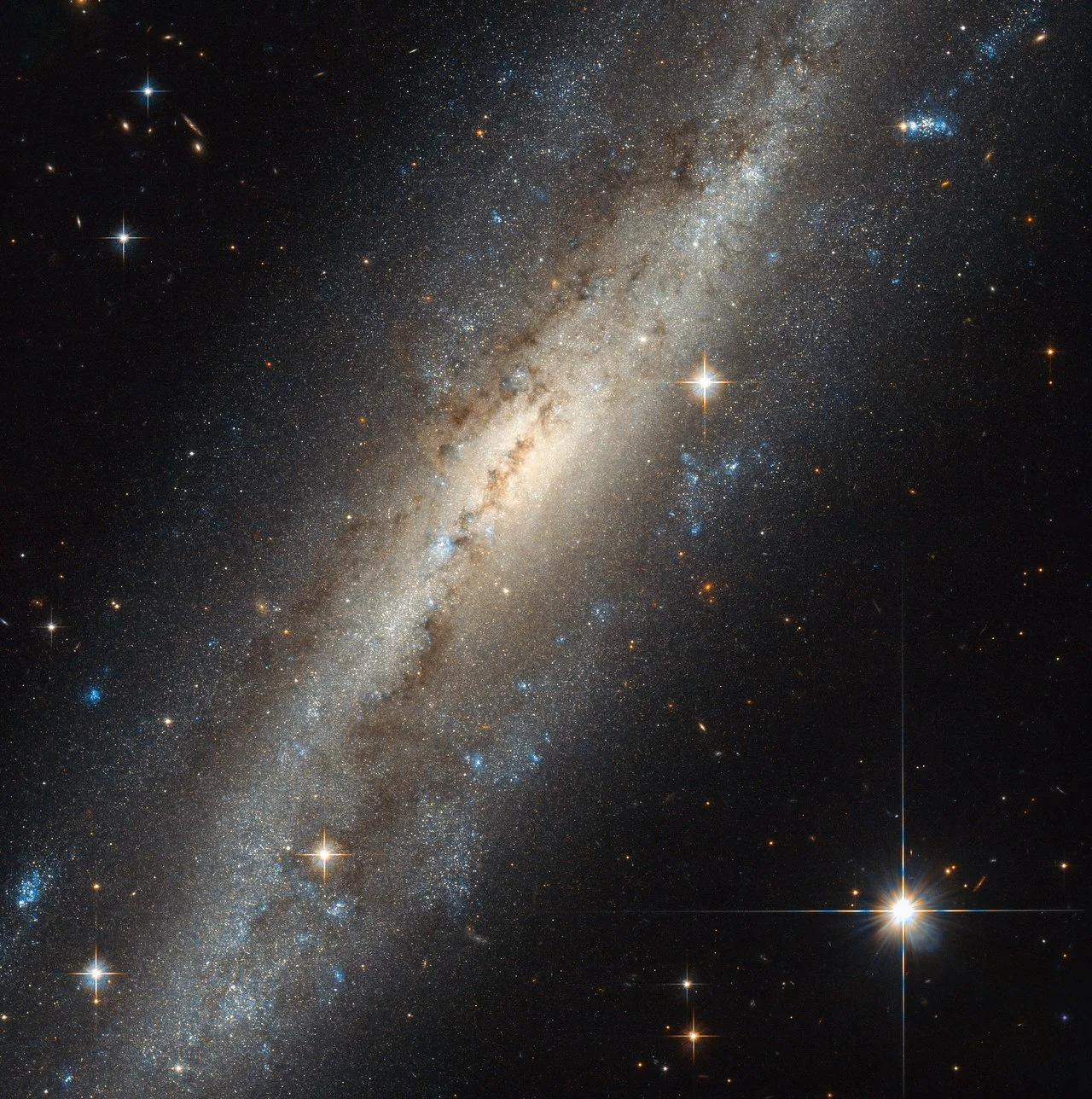
    The Andromeda constellation is home to the pictured galaxy known as NGC 7640.

    Many different classifications are used to identify galaxies by shape and structure — NGC 7640 is a barred spiral type. These are recognizable by their spiral arms, which fan out not from a circular core, but from an elongated bar cutting through the galaxy’s center. Our home galaxy, the Milky Way, is also a barred spiral galaxy.

    NGC 7640 might not look much like a spiral in this image, but this is due to the orientation of the galaxy with respect to Earth — or to Hubble, which acted as photographer in this case! We often do not see galaxies face on, which can make features such as spiral arms less obvious.

    There is evidence that NGC 7640 has experienced some kind of interaction in its past.

    Galaxies contain vast amounts of mass, and therefore affect one another via gravity. Sometimes these interactions can be mild, and sometimes hugely dramatic, with two or more colliding and merging into a new, bigger galaxy.

    Understanding the history of a galaxy, and what interactions it has experienced, helps astronomers to improve their understanding of how galaxies — and the stars within them — form.

    Image Credit: ESA / Hubble and NASA

  • Andromeda Galaxy

    Andromeda Galaxy

    The Andromeda Galaxy, also called Messier 31 or M31, is the nearest major galaxy to the Milky Way.

    It is 2.5 million light years away from Earth and is the other major member of the Local Group, our local collection of galaxies.

    Like the Milky Way, it is a barred spiral galaxy, so-called for the bar-like structure formed by the stars in its centre.


    Andromeda is about 260,000 light-years wide, according to NASA, making it the largest galaxy in the Local Group. However, its mass is comparable to or even less than that of the Milky Way, according to NASA JPL

    Scientists think the galaxy could be anywhere from 5 and 10 billion years old. However, it may not have existed in its current form until two or three billion years ago, when two smaller galaxies orbiting each other merged to form the current Andromeda Galaxy, according to a 2018 study.

    Can I see Andromeda?

    Andromeda is visible to the naked eye but only when viewed in dark skies and ideally on a moonless night. In many places, it is visible the entire year for at least part of the night but is highest in the sky and therefore easiest to spot in August and September, according to EarthSky. There are several ways to find Andromeda. One of the easiest is to locate the constellation Cassiopeia, which forms a kind of M or W shape in the sky. The lowest point of the W is the star Schedar, which points directly at Andromeda.

    Using a high-powered telescope in dark skies, it is also possible to observe some of the star clusters within the galaxy, such as the bright cluster Mayall II, also called Globular One or G1. This cluster is so bright that some researchers think it is the remnant of the core of a dwarf galaxy that merged with Andromeda in the distant past.

    What will happen when we hit the Andromeda galaxy?

    When the Milky Way and Andromeda merge in about 4.5 billion years, they will form a huge elliptical galaxy. Chances are that our solar system will be unaffected. We might be pulled away from the centre of the galaxy, or we might be totally ejected from it. Stars are so far apart that any sort of collision is extremely unlikely. However, it is almost certain that the increasing luminosity of our sun will have caused Earth to become inhospitable to all multicellular life by this point, so we will not be around to find out.

    Is Andromeda bigger than the Milky Way?

    Andromeda is larger than the Milky Way in terms of the distance it extends. However, the two galaxies are comparable in mass, and it is hard to say which one is more massive.

    Colliding galaxies:

    Andromeda and the Milky Way are slowly drifting towards each other, leading scientists to conclude that they will collide about 4.5 billion years from now, according to a 2019 study. The two galaxies will form a giant elliptical, or oval, galaxy, according to NASA.

    It is not clear what might happen to our planet and solar system during this merger. Scientists think we might be swept about much further away from the core of the Milky Way, according to NASA, or be completely ejected from our galaxy. However, neither one of these things would impact our solar system.


    Unfortunately (or fortunately) for us, we will not be around to find out what happens. By around a billion years from now, the sun’s increasing luminosity is predicted to have disrupted life on Earth so thoroughly that only single-celled organisms will be left.


    A possible exoplanet:

    In 1999, scientists noticed a minute change in Andromeda known as a microlensing event, which they called PA-99-N2. Gravitational lensing happens when something extremely massive, like a large galaxy, bends the light of a far more distant background object behind it, sometimes creating multiple distorted images of that object. With microlensing, a smaller object, like a star or planet, causes this type of distortion. The distortion of light causes the background source to become temporarily brighter, according to the Planetary Society.

    One explanation for this event is that the background object was a red giant star in Andromeda, and the lensing object was another star in the galaxy, with a planet orbiting it. Scientists think this star has a planet because of the pattern of the brightening during the event. If this planet exists, it would be the first exoplanet discovered in another galaxy. The planet may be around 6.34 times the mass of Jupiter, according to a 2012 study.

    Andromeda and the Great Debate

    In the 1920s, the distant galaxy became part of the Great Debate between American astronomers Harlow Shapley and Heber Curtis. At the time, astronomers thought the Milky Way composed the whole universe, and the strange patches such as Andromeda (known as “nebulas” at the time) lay inside of them. Curtis had spotted various novas in Andromeda and argued it was not a “nebula” but instead that it was a separate galaxy.

    The discussion was not concluded until 1925 when Edwin Hubble identified a special kind of star known as a Cepheid variable — a star whose characteristics allow for precise measurements of distance — within Andromeda. Because Shapley had previously determined that the Milky Way was only 100,000 light-years across, Hubble’s calculations revealed that the fuzzy patch was too far away to lie within the Milky Way.

    What are some major similarities and differences between Andromeda and our Milky Way galaxy?

    Both are intermediate-type spirals, with 3-D central bars (not very strong ones). M31 is often reported as more massive. Both central black holes are relatively inactive. M31 is even less active than the Milky Way at least at present.

    M31 probably has more globular clusters. Both have families of a dozen or more dwarf galaxies around them, the Milky Way’s dwarf galaxies are better inventoried than M31 because they’re easier to observe.

    How similar would they look if we could see both from the outside? 

    Not quite sure, because we cannot see our own from outside!

    What are some ways we think Andromeda might have evolved and changed over time?

    The current understanding is that both the Milky Way and M31 (and large galaxies in general) have formed from mergers of a few smaller ones and ongoing accretion of dwarf galaxies.

    The evidence is streams of stars moving together in the Milky Way that are left from such dwarfs coming close and getting torn apart. As a result, there are lots of stars in the Milky Way that are older than the age of the fully assembled galaxy. Mergers still occur from time to time for both the Milky Way and M31. Both probably also have had their nuclei more active in the past when the central black holes experienced episodes of accreting gas and/or having a star come close enough to get torn apart (tidal disruption event) and fall into the black hole.

    Why do researchers think Andromeda will collide or merge with our galaxy?

    The two galaxies are moving toward each other now at about 100 km/sec and are about 685,000 parsecs apart, so some interaction is inevitable. Probably a glancing collision because the Milky Way and M31 are not aimed exactly straight at one another.

    How would our galaxy merge with Andromeda impact Earth and our solar system?

    Not predictable for certain (because there is some tiny probability of a near collision of the sun with an M31 star) but certainly fairly minor because the stars are so far apart compared to their sizes and the sizes of the main part of the solar system.

    Gas from the two galaxies will collide, forming a shockwave and very likely trigger an episode of star formation so that a few million years later, we would probably have lots more young, bright stars near enough to be naked-eye objects.

    Resources:

    1. NASA. “The Galaxy Next Door”. https://www.nasa.gov/image-article/galaxy-next-door/

    2. NASA Jet Propulsion Laboratory. “Cool, New Views of Andromeda Galaxy.” https://www.jpl.nasa.gov/news/cool-new-views-of-andromeda-galaxy

    3. Schindler, K. “Views From Mars Hill: Andromeda Galaxy,” Lowell Observatory. https://lowell.edu/views-from-mars-hill-andromeda-galaxy/

    4. Hammer F et al. “A 2–3 billion-year-old major merger paradigm for the Andromeda galaxy and its outskirts,” Monthly Notices of the Royal Astronomical Society. https://academic.oup.com/mnras/article/475/2/2754/4839413

    5. McClure, B. “Andromeda galaxy: All you need to know,” EarthSky. https://earthsky.org/clusters-nebulae-galaxies/andromeda-galaxy-closest-spiral-to-milky-way/

    6. Refreshing Views. “Star Clusters in Another Galaxy”. https://www.youtube.com/watch

    7. Ma J et al. “Structural parameters of Mayall II = G1 in M31,” Monthly Notices of the Royal Astronomical Society. https://academic.oup.com/mnras/article/376/4/1621/1014745

    8. van der Marel R et al. “First Gaia Dynamics of the Andromeda System: DR2 Proper Motions, Orbits, and Rotation of M31 and M33,” The Astrophysical Journal. https://iopscience.iop.org/article/10.3847/1538-4357/ab001b

    9. NASA Hubble Mission Team. “NASA’s Hubble Shows Milky Way is Destined for Head-On Collision.” https://science.nasa.gov/missions/hubble/nasas-hubble-shows-milky-way-is-destined-for-head-on-collision/


    10. Muir H. “Galactic merger to ‘evict’ Sun and Earth,” New Scientist. https://www.newscientist.com/article/dn11852-galactic-merger-to-evict-sun-and-earth/#.VDVdDvl_uVB

    11. O’Malley-James, Jack T et al. “Swansong biospheres II: the final signs of life on terrestrial planets near the end of their habitable lifetimes,” International Journal of Astrobiology. https://www.cambridge.org/core/journals/international-journal-of-astrobiology/article/abs/swansong-biospheres-ii-the-final-signs-of-life-on-terrestrial-planets-near-the-end-of-their-habitable-lifetimes/EC5E8031028203F2EA3866C170575922#

    12. The Planetary Society. “Space-Warping Planets: The Microlensing Method.” https://www.planetary.org/articles/space-warping-planets-the-microlensing-method

    13. Ingrosso, G et al. “Detection of exoplanets in M31 with Pixel-Lensing: The Event PA-99-N2 Case,” The Twelfth Marcel Grossmann Meeting. https://www.worldscientific.com/doi/abs/10.1142/9789814374552_0433


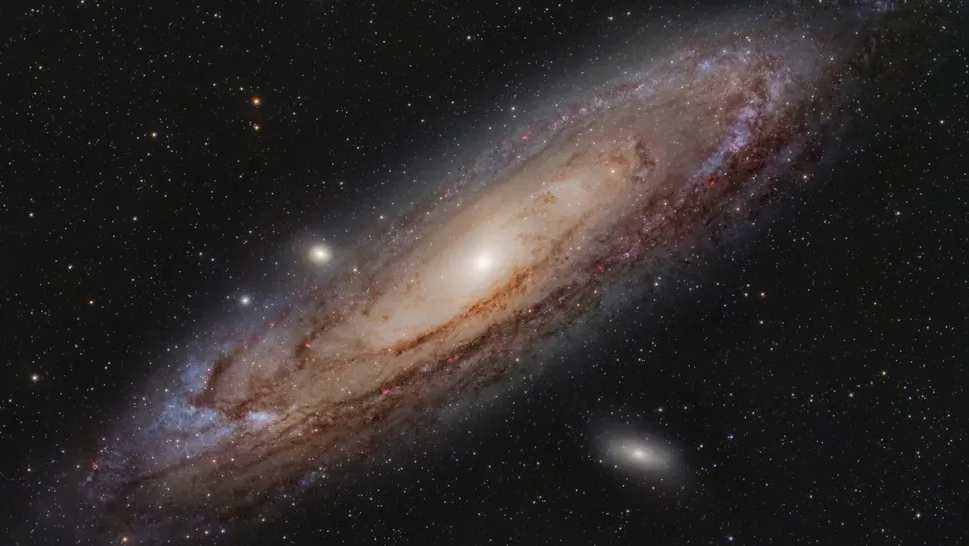
    Image #1: Image of the andromeda galaxy showing swirling arms of gas and dust with a bright centre. (Image credit: Westend61 via Getty Images)

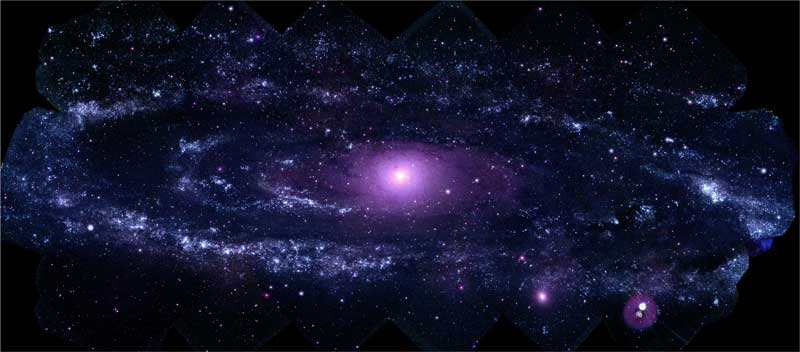
    Image #2: This mosaic of M31 merges 330 individual images taken by the Ultraviolet/Optical Telescope aboard NASA’s Swift spacecraft. It is the highest-resolution image of the galaxy ever recorded in the ultraviolet. The image shows a region 200,000 light-years wide and 100,000 light-years high (100 arcminutes by 50 arcminutes). (Image credit: NASA/Swift/Stefan Immler (GSFC) and Erin Grand (UMCP))

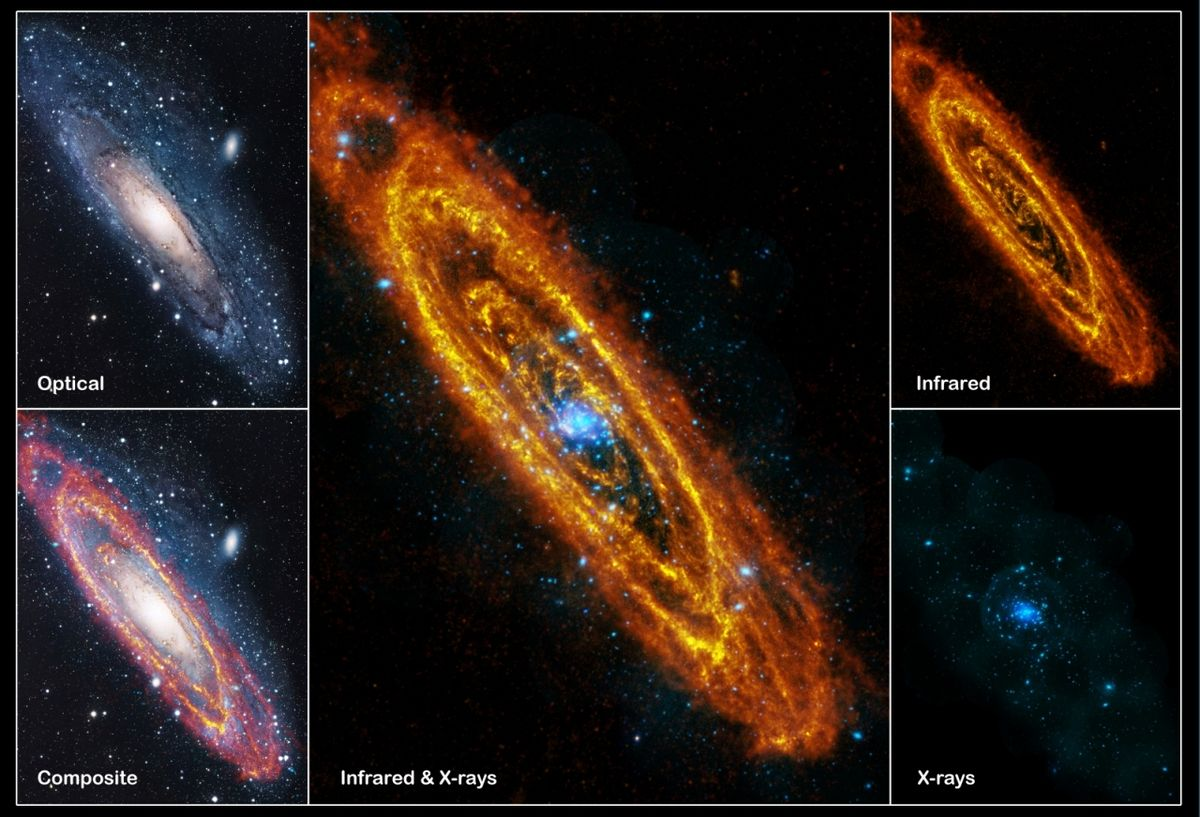
    Image #3: The Andromeda galaxy in the visible, infrared, and X-ray light spectrums, using data from the European Space Agency’s Herschel (infrared) and XMM-Newton (X-ray) observatories, as well as the optical image by Robert Gendler.  (Image credit: infrared: ESA/Herschel/PACS/SPIRE/J. Fritz, U. Gent; X-ray: ESA/XMM-Newton/EPIC/W. Pietsch, MPE; optical: R. Gendler)
  • Cosmic Campfire – DEM L 190

    Cosmic Campfire – DEM L 190

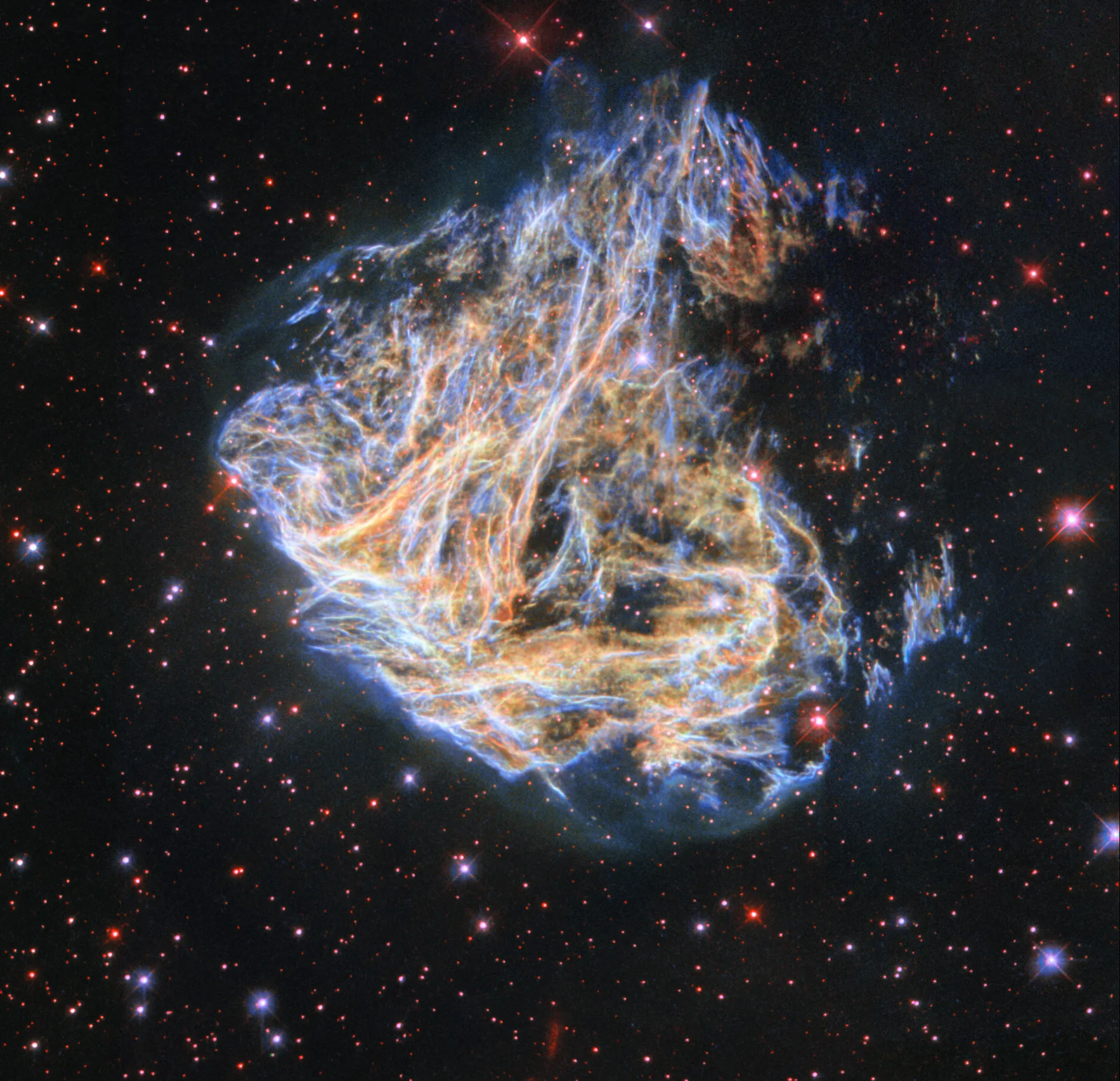
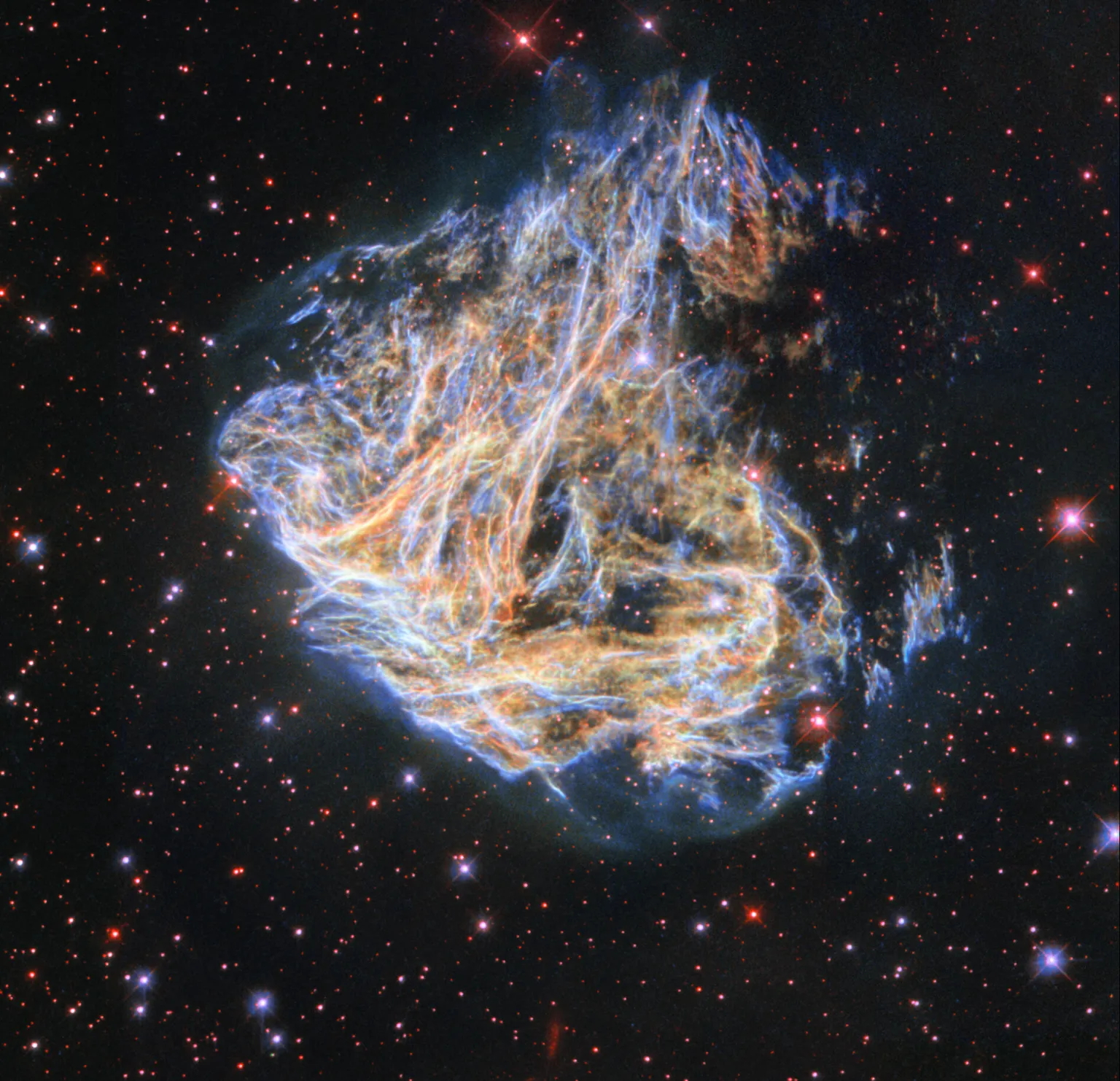
    This enthralling image of the supernova remnant DEM L 190, captured by the Hubble Space Telescope, provides a glimpse into the cataclysmic death of a massive star in the Large Magellanic Cloud, the Milky Way’s small galactic neighbour. Located approximately 160,000 light-years away from Earth in the constellation Dorado, DEM L 190, also known as LMC N49, is one of the brightest supernova remnants in the Large Magellanic Cloud.

    The delicate filaments of the remnant, which resemble puffs of smoke and sparks from a campfire, are layers of debris from the stellar explosion. These filaments, along with other materials from the blast, will eventually contribute to the formation of a new generation of stars.

    Astronomers studied DEM L 190 to understand the interaction between the supernova remnant and the interstellar medium. The intricate structure houses a powerful, rapidly spinning neutron star known as a magnetar. This exotic object undergoes episodes of gamma-ray emissions and is classified as a “soft gamma-ray repeater,” referring to its emission of photons with lower energy than typical gamma-ray bursts. The neutron star also emits X-rays with energies slightly less than those of soft gamma rays.

    The stunning image is a composite of data from two different astronomical projects using Hubble Space Telescope’s Wide Field and Planetary Camera 2 (WFPC2).

    Source: NASA

    Image Credit: ESA/Hubble & NASA, S. Kulkarni, Y. Chu

  • Deep imaging techniques reveal that galaxies are much much bigger than previously thought

    Deep imaging techniques reveal that galaxies are much much bigger than previously thought

    by ARC Centre of Excellence for All Sky Astrophysics in 3D (ASTRO 3D)

    September 06, 2024

    If this galaxy is typical, then the study, published today in Nature Astronomy, indicates that our galaxy is already interacting with its closest neighbour, Andromeda.

    Where does a galaxy end and deep space begin? It seems like a simple question until you look more closely at the gas that surrounds galaxies, known as the circumgalactic medium.

    The halo of gas surrounding the stellar disk accounts for about 70% of the mass of the galaxy—excluding dark matter—but until now it has remained something of a mystery. In the past, we have only been able to observe the gas by measuring the light from a background object, such as a quasar, that is absorbed by the gas.

    That limits the picture of the cloud to a pencil-like beam.

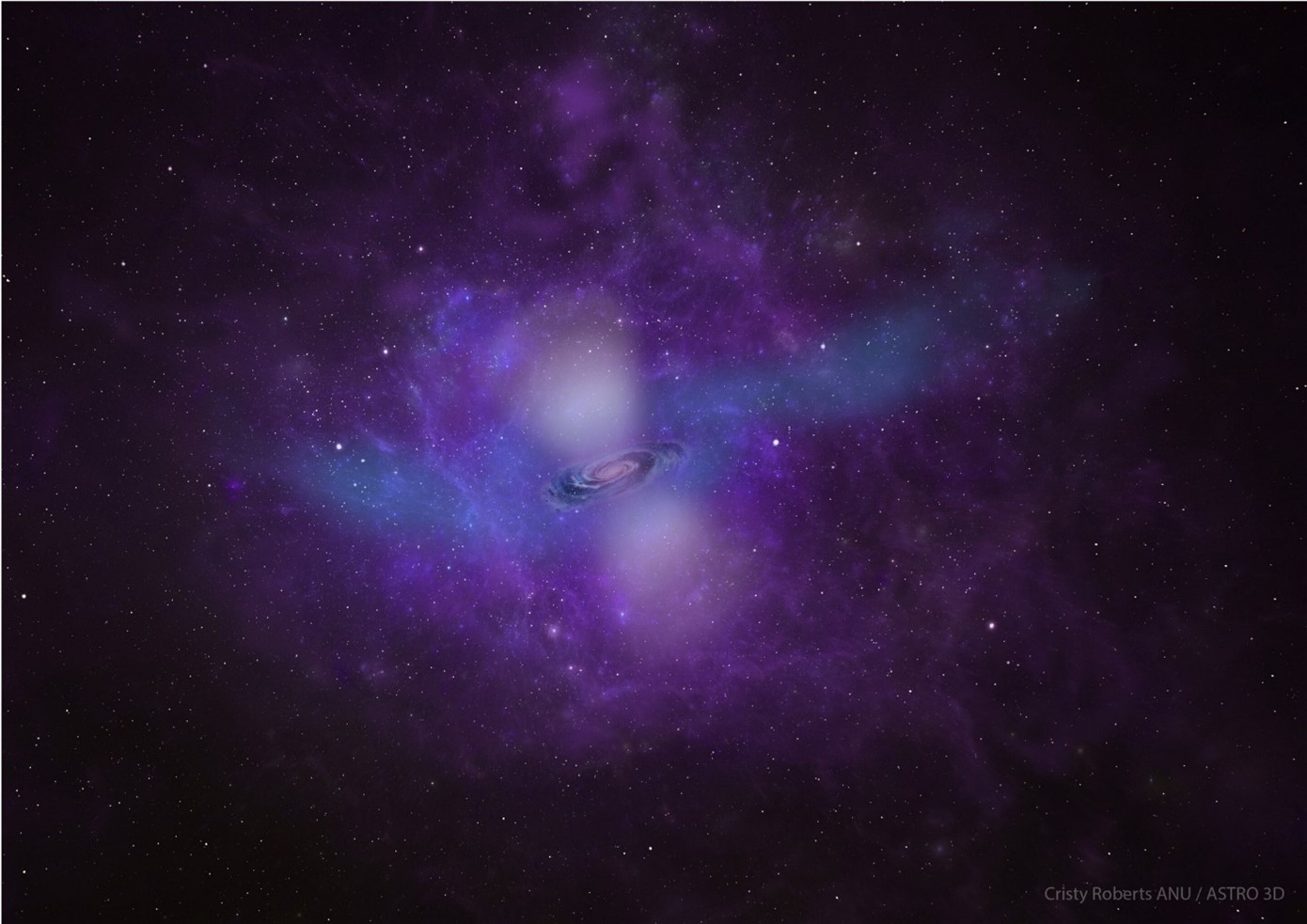
    A new study, however, has observed the circumgalactic medium of a star-bursting galaxy 270 million light years away, using new deep imaging techniques that were able to detect the cloud of gas glowing outside of the galaxy 100,000 light years into space, as far as they were able to look.

    To envisage the vastness of that cloud of gas, consider that the galaxy’s starlight—what we would typically view as the disk—extends just 7,800 light years from its centre.

    The current study observed the physical connection of hydrogen and oxygen from the centre of the galaxy far into space and showed that the physical conditions of the gas changed.

    “We found it everywhere we looked, which was really exciting and kind of surprising,” says Associate Professor Nikole M. Nielsen, lead author of the paper, and a researcher with Swinburne University, and ASTRO 3D and an Assistant Professor at the University of Oklahoma.

    Other authors of the paper came from Swinburne, the University of Texas at Austin, the California Institute of Technology, Pasadena, the University of California, San Diego, and Durham University.

    “We’re now seeing where the galaxy’s influence stops, the transition where it becomes part of more of what’s surrounding the galaxy, and, eventually, where it joins the wider cosmic web and other galaxies. These are all usually fuzzy boundaries,” says Dr. Nielsen.

    “But in this case, we seem to have found a fairly clear boundary in this galaxy between its interstellar medium and its circumgalactic medium.”

    The study observed stars ionizing gas with their photons within the galaxy.

    “In the CGM, the gas is being heated by something other than typical conditions inside galaxies. This likely includes heating from the diffuse emissions from the collective galaxies in the universe and possibly some contribution is due to shocks,” says Dr. Nielsen.

    “It’s this interesting change that is important and provides some answers to the question of where a galaxy ends,” she says.

    The discovery has been made possible thanks to the Keck Cosmic Web Imager (KCWI) on the 10-meter Keck telescope in Hawaii, which contains an integral field spectrograph and is one of the most sensitive instruments of its kind in operation.

    “These one-of-a-kind observations require the very dark sky that is only available at the Keck Observatory on Mauna Kea,” said one of the paper’s authors, Swinburne’s Associate Professor Deanne Fisher.

    ASTRO 3D scientists gained access to KCWI through Swinburne University.

    “Swinburne’s Partnership with the W. M. Keck Observatory has allowed our team to really push the boundaries of what is possible,” says another author, Associate Professor Glenn Kacprzak. “KCWI has really changed the game on how we can now measure and quantify the diffuse gas around galaxies.”

    Thanks to the instrument, rather than making a single observation providing a single spectrum of the gas in the galaxy, scientists can now obtain thousands of spectra simultaneously with one image from KCWI.

    “It is the very first time that we have been able to take a photograph of this halo of matter around a galaxy,” says Professor Emma Ryan-Weber, the Director of ASTRO 3D.

    The study adds another piece to the puzzle that is one of the big questions in astronomy and galaxy evolution—how do galaxies evolve? How do they get their gas? How do they process that gas? Where does that gas go.

    “The circumgalactic medium plays a huge role in that cycling of that gas,” says Dr. Nielsen. “So, being able to understand what the CGM looks like around galaxies of different types—ones that are star-forming, those that are no longer star-forming, and those that are transitioning between the two—we can observe differences in this gas, which might drive the differences within the galaxies themselves, and changes in this reservoir may actually be driving the changes in the galaxy itself.”

    The study speaks directly to the ASTRO 3D’s mission. “It helps us understand how galaxies build mass over time,” says Professor Ryan-Weber.

    The findings could also hold implications for how different galaxies interact and how they might impact each other.

    “It’s highly likely that the CGMs of our own Milky Way and Andromeda are already overlapping and interacting,” says Dr. Nielsen.

    Journal:

    An emission map of the disk–circumgalactic medium transition in starburst IRAS 08339+6517, Nature Astronomy (2024). DOI: 10.1038/s41550-024-02365-x


    Image:

    Visualization of the gas shroud of starburst galaxy IRAS 08339+6517. Credit: Cristy Roberts ANU/ASTRO 3D

    Image:

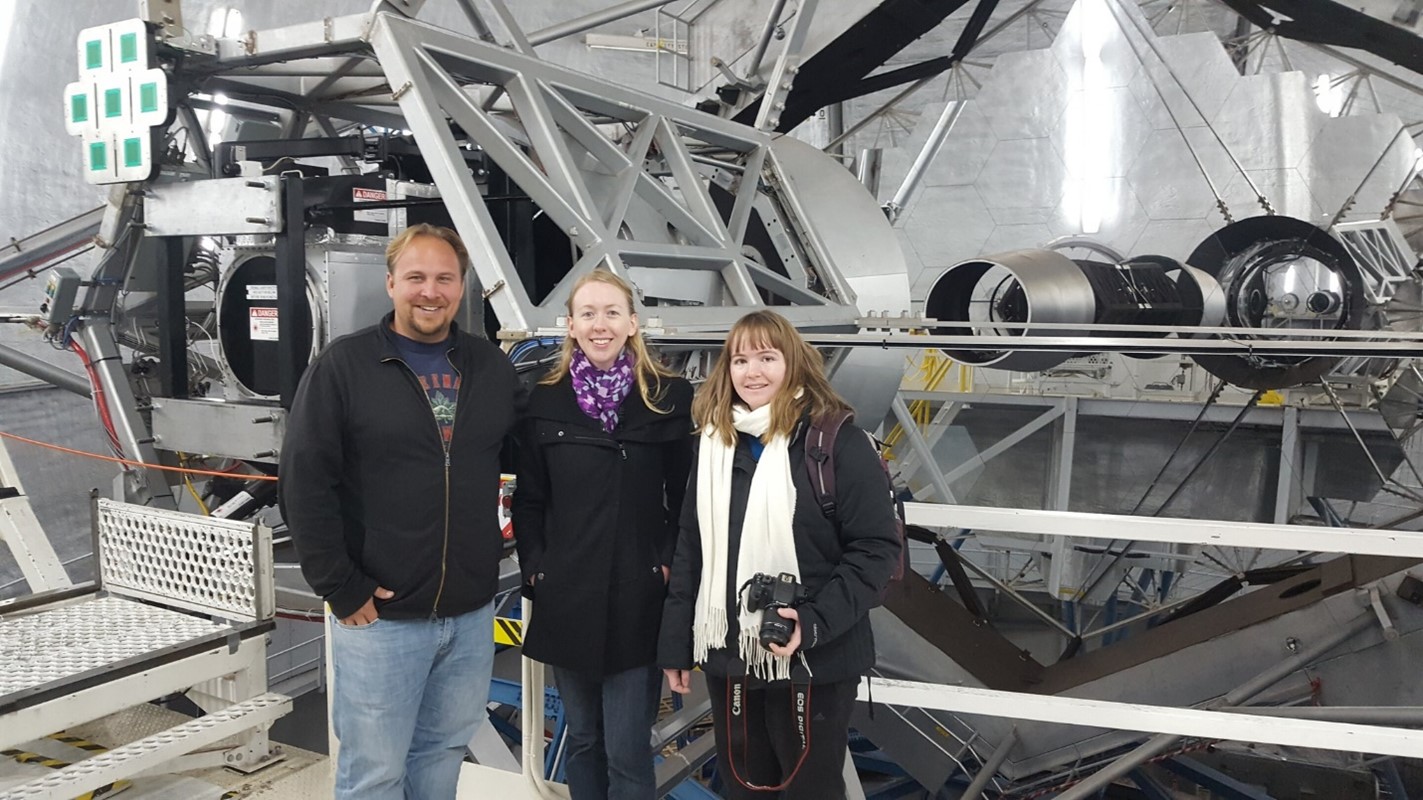
    Lead author, Nikki Nielsen with colleagues Glenn Kacprzak and Stephanie Pointon in front of the Keck mirror. Credit: Provided